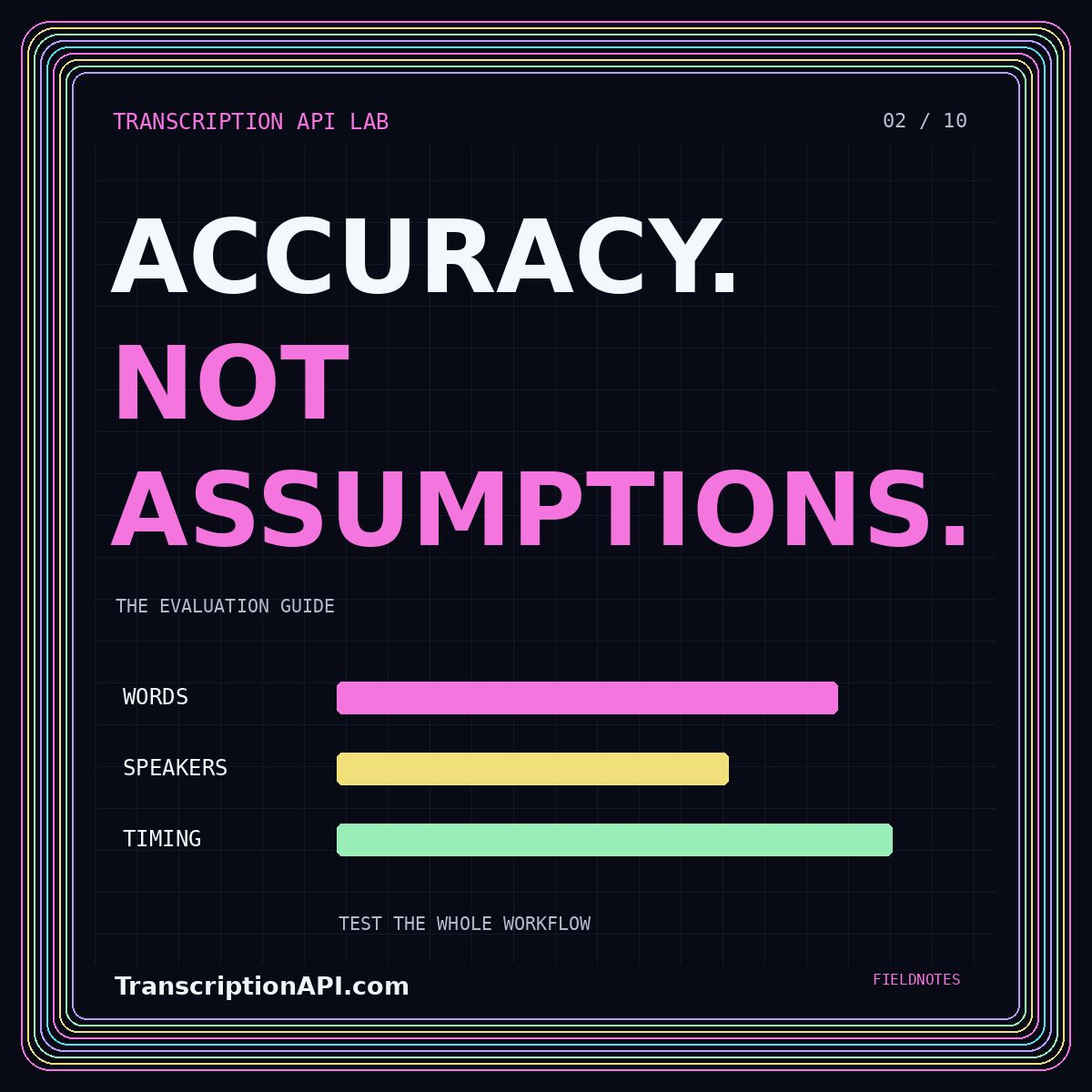
How to evaluate AI transcription API accuracy on your own audio
Build a representative test collection and measure the mistakes that matter beyond a headline accuracy score.
Read the field guide02 / QUALITY & EVALUATION
Measure the words.
Question the confidence.
An AI transcription API should be evaluated on the recordings your product actually handles. A fluent sentence is not proof of faithful recognition. Build a test collection that reveals important mistakes and connect the results to a clearly defined use case.
Read the complete field guideInclude the devices, languages, recording lengths, and acoustic conditions that occur in your workload. Keep development material separate from the held-out evaluation collection. Document selection and permissions instead of describing a convenient sample as universally representative.
Prepare reviewed reference transcripts under a consistent style guide. Decide how normalization handles case, numbers, punctuation, and uncertain speech. Keep the original and normalized text so that a scoring rule does not hide a meaning-changing difference.
Word error rate is useful for a lexical comparison, but a public quotation or task extractor may need additional checks. Track names, quantities, negation, speaker attribution, and unsupported text separately. Do not let one aggregate number conceal an important weak subset.
Report the number and duration of examples behind each observation. Label small samples as limited. Keep review effort and end-to-end completion time alongside text accuracy when those factors affect whether the workflow is usable.
The Whisper model card documents hallucinated or repetitive text and uneven performance across languages. Treat those documented limitations as a reason to test relevant edge cases, not as a universal result for every model or service.
Preserve raw output and reviewed versions separately. Add silence, unclear passages, and previous failures to regression tests. Recheck a configuration when a model, conversion step, or input population changes instead of assuming an earlier evaluation remains sufficient.
Primary reference: Whisper model card. Provider-specific details should be checked against the version and configuration you use.
MAKE THE CHOICE EXPLICIT
Agree on reference style and the kinds of mistakes that block release.
Keep source audio, configuration, timings, failure outcomes, and review notes together.
Maintain a regression set and review changes against the same acceptance rules.
There is no defensible single figure without a defined workload, model, configuration, and evaluation method. Measure representative recordings and report limitations alongside the results.
No. Treat any confidence information as provider-specific evidence to evaluate, not a replacement for source checking. Missing confidence should remain missing rather than becoming a fabricated score.
KEEP EXPLORING
Build a representative test collection and measure the mistakes that matter beyond a headline accuracy score.
Read the field guide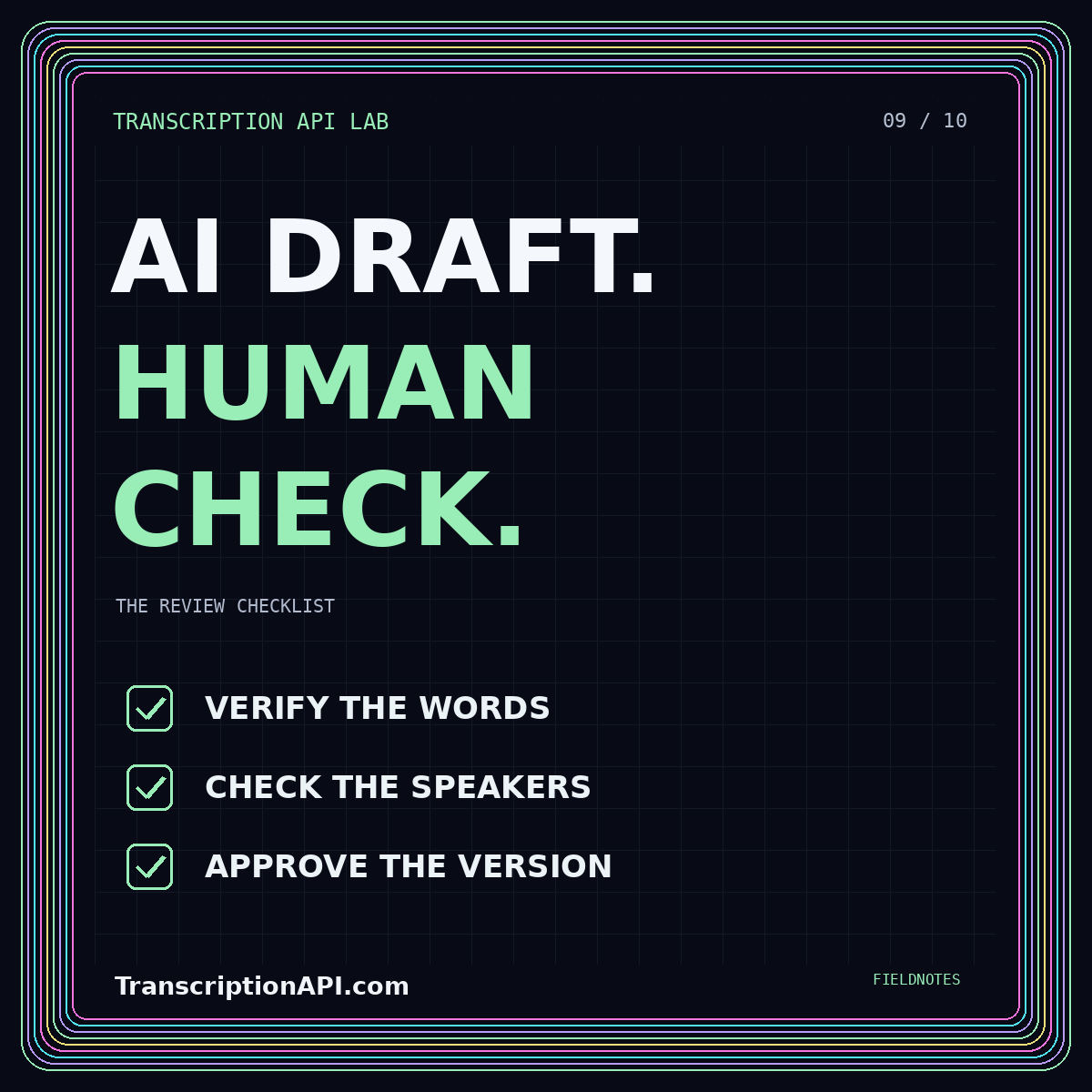
Verify names, quantities, speaker assignments, uncertainty, and the final export before approving a transcript.
Read the field guide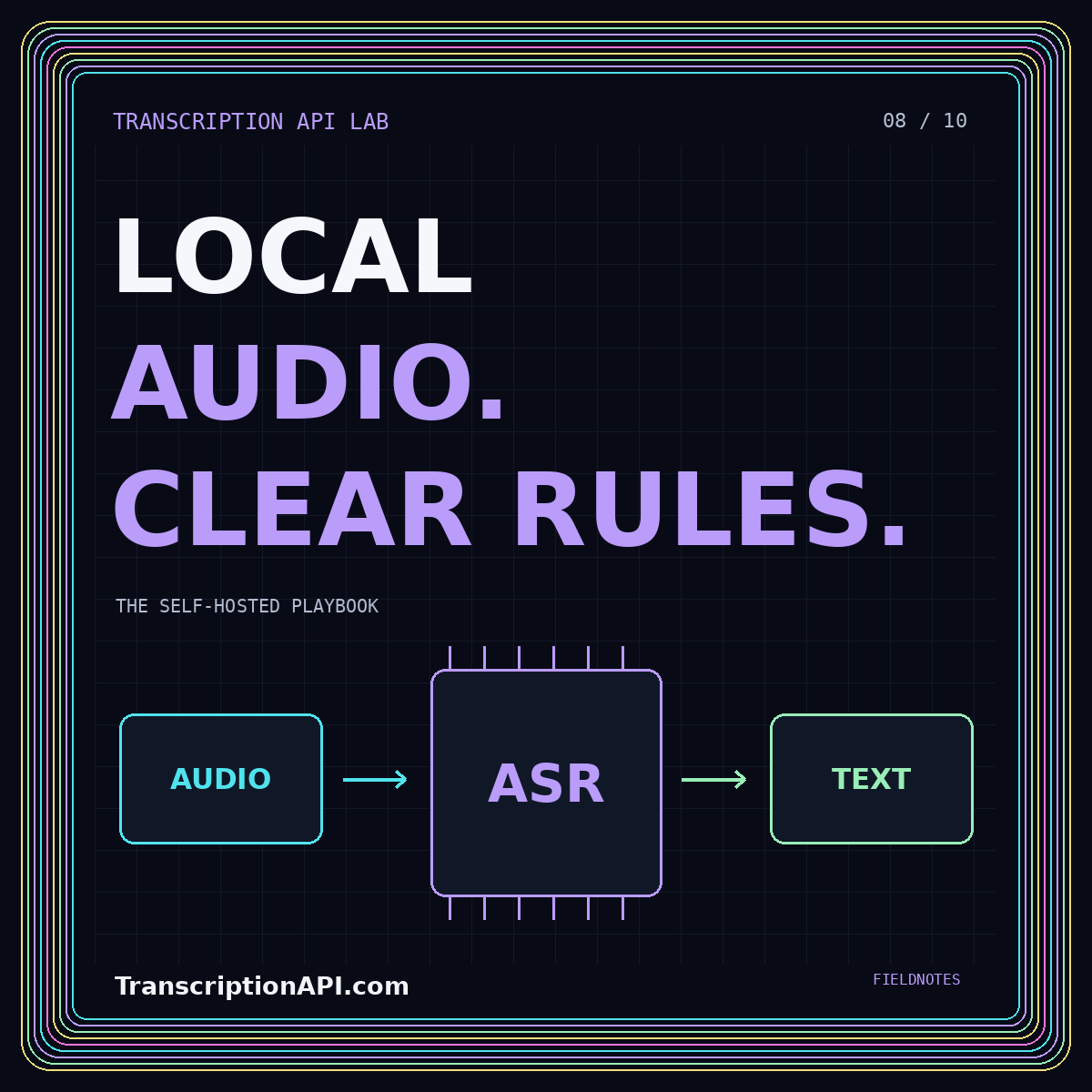
Separate local recognition from language processing, measure capacity, and map every storage and network boundary.
Read the field guideHave a correction, a topic suggestion, or a workflow worth exploring?