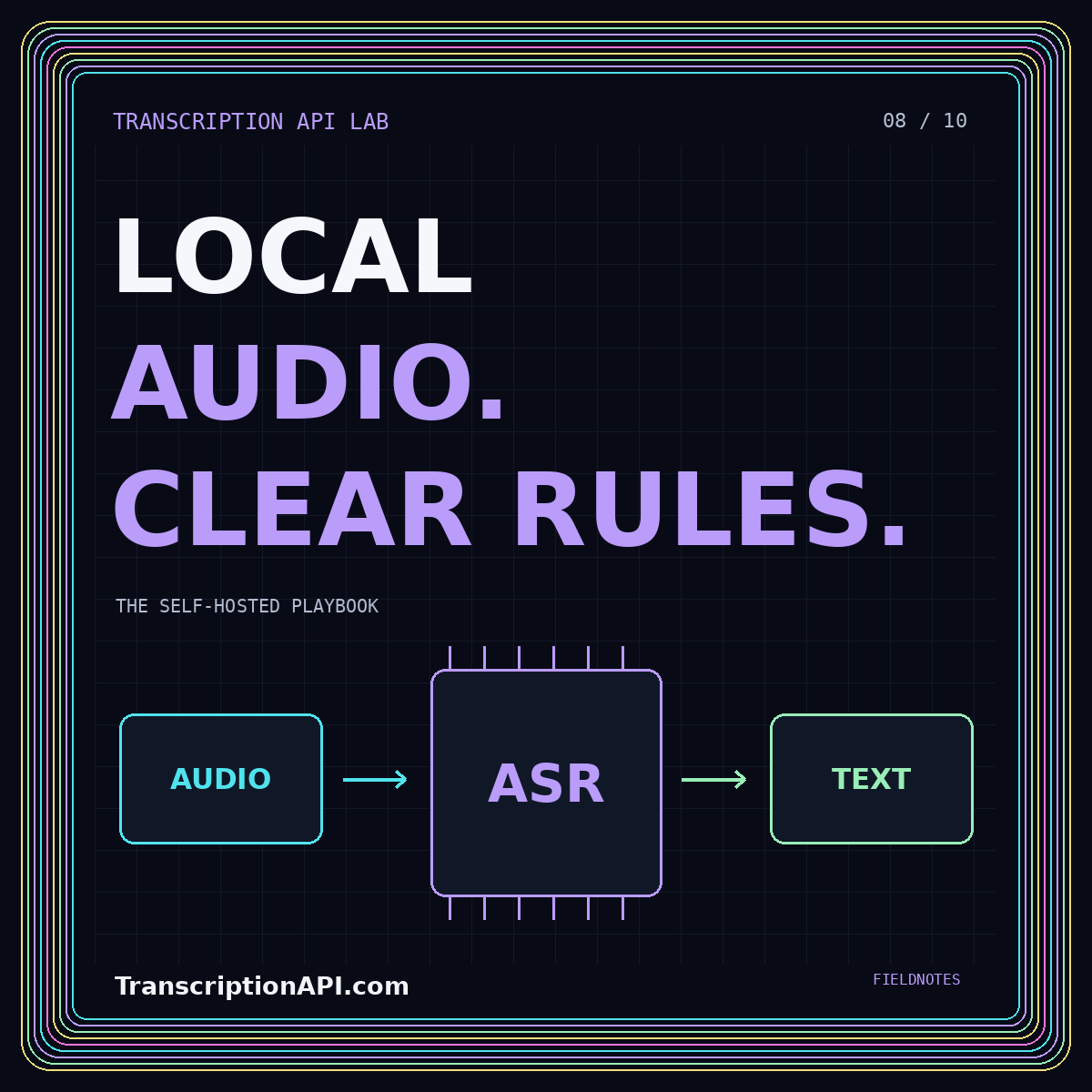
A local LLM transcription API is best understood as a pipeline, not a single magic model. One component recognizes speech from audio. Another may summarize or answer questions about the resulting text. An application layer manages files, jobs, permissions, and results. Running some components locally does not automatically make every part of the workflow offline or private.
This guide proposes a deployment plan for teams evaluating self-hosted speech recognition with optional local language-model processing. It does not claim that TranscriptionAPI.com hosts an endpoint or supplies a server package. Use the Local LLM Transcription API overview to map the components, then test them against a bounded workload before exposing the system to real users.
Separate recognition from language processing
A text-only language model does not become a speech recognizer merely because an application sends it a filename. Your architecture needs a component that accepts and processes the actual audio. The resulting transcript can then become input to a separate text task. Some systems combine capabilities, but the application still needs a clear contract for each transformation and its output.
Keep the original recognition result separate from summaries, extracted tasks, or rewritten notes. Store the model and configuration used for each stage. When a summary contains a mistake, that separation lets you ask whether the source transcript was wrong or the later interpretation introduced the error. Without it, a single polished text field can hide where the problem began.
Choose a concrete local recognition runtime
The official whisper.cpp repository documents a C/C++ implementation of Whisper inference, supported platforms, model handling, and example applications. It provides a concrete starting point for exploring local recognition. Its examples and capabilities should be checked against the version you deploy; the existence of a local runtime does not establish performance on your hardware or suitability for your workload.
Pin the runtime version and record the model artifact you select. Keep a copy of the configuration and the relevant license information in your internal deployment records. Avoid building an operating process around an unversioned command copied from an old tutorial. A reproducible local setup is one you can reinstall, test, and explain without relying on whatever happens to be the newest release.
Benchmark the complete job on your hardware
Use representative recordings rather than a single short clip. Measure media decoding, model loading, recognition, serialization, and any subsequent text processing. Record the hardware, operating system, runtime version, model, and concurrency. Distinguish the first job after startup from later jobs if they behave differently. A useful benchmark describes the conditions under which the result was observed.
Watch memory and queue behavior while several jobs are submitted. Do not assume that a configuration that handles one recording comfortably will handle several simultaneous requests. Define the acceptable completion window for your product. An overnight archive job and an interactive dictation experience impose very different constraints, even when both use the same recognition model and machine.
Put a durable queue around expensive work
Separate the process that accepts a job from the worker that runs recognition. The intake component should validate the request, create a durable record, and acknowledge acceptance. The worker can then process the recording under controlled concurrency. This architecture recommendation avoids tying a long job's lifetime to one browser connection or a short application timeout.
Give every attempt an identifier and an explicit terminal state. Store failures in a form that allows a person to determine whether the source was unsupported, capacity was unavailable, or execution failed. A restart should not make jobs disappear. The transcription integration guide develops these job-state and retry concepts independently of the chosen recognition engine.
Define the local trust boundary
Draw the path taken by recordings, transcripts, model downloads, logs, backups, and optional language-model requests. Mark every point where data can leave the machine or network. A local recognition worker may still be surrounded by remote storage, telemetry, or external summarization. Describe the actual architecture rather than applying an unconditional “audio never leaves” claim to a partially local system.
Test the desired network behavior in a controlled environment. Install necessary artifacts before an offline test, then inspect whether routine operation tries to fetch anything else. Document which features stop working without connectivity. Do not remove security updates permanently in pursuit of an offline label; define a controlled maintenance process appropriate to the environment and the information being processed.
Protect the interface, not just the model
Keep a development server bound to the intended local interface. Before allowing access from other machines, add appropriate authentication, authorization, transport protection, and request limits in the surrounding application. A recognizer's example server should not be assumed to provide every control your deployment needs. Review the actual behavior and configuration rather than treating “self-hosted” as a security guarantee.
Avoid putting permanent service credentials into browser code or shared example files. Restrict access to recordings and results by job ownership or the equivalent rule in your product. Validate filenames and media inputs before processing them. Keep operational logs useful without copying complete transcripts into broadly accessible monitoring tools. These controls belong to the application boundary even when inference runs entirely on one machine.
Budget for capacity and maintenance
Local operation changes the cost structure; it does not eliminate cost. Account for hardware capacity, storage, energy, engineering time, updates, and incident response according to your organization's budgeting method. Estimate how many recordings arrive during peak periods and how long the queue may grow. Keep those assumptions visible rather than claiming unlimited processing because no per-minute API charge is present.
Compare configurations using the same quality and review requirements. A smaller model that finishes quickly may produce a different correction workload from a larger model. Measure that tradeoff on your recordings. The transcription service cost model shows how recognition cost and human review can be combined without pretending that an illustrative calculation is a vendor benchmark.
Add a language model only for a defined task
Start with a bounded text task such as drafting a short summary from a reviewed transcript. Require the output to identify the source segments supporting important statements. Keep the task instructions separate from the transcript content. Do not allow words spoken in a recording to become authoritative application instructions or permission to run tools, change settings, or send information elsewhere.
Treat the language-model result as derived content with its own review status. A complete recognition job does not mean a generated action list is approved. Keep uncertain names and unresolved passages visible to the later stage rather than asking it to guess. Local execution can change where processing happens, but it does not remove the need to verify interpretations against the source.
Plan upgrades and recovery before launch
Keep a regression collection containing ordinary recordings and known failures. Run it before changing the runtime, model, conversion settings, or worker configuration. Record the outcomes and define a rollback path. An upgrade should not silently alter existing approved transcripts; create a new result version when reprocessing is intentional and preserve the relationship to the original job.
Test a worker crash, a full disk, an interrupted upload, and an application restart. Confirm that files are not left indefinitely in an unknown state and that users receive understandable outcomes. Set cleanup rules for temporary processing copies and unfinished jobs. Operational reliability is a property of the whole deployment, not merely of whether the recognition executable runs successfully once.
Conclusion: local is an architecture decision
A useful local transcription system has defined components, measured capacity, controlled data paths, and a recovery process. Begin with recognition, add only the text tasks the product needs, and keep every transformation traceable. Evaluate the actual deployment rather than relying on an offline or privacy label. That approach gives teams a practical basis for choosing where audio processing should run.