Chat transcription API workflows: ground answers in the recording
Design source-linked answers, permission-aware retrieval, and an explicit boundary between speech and action.
Read the field guide10 / CONNECTED AI WORKFLOWS
Let the transcript
keep the answer grounded.
A chat transcription workflow can turn a conversation record into a useful question-answering experience. Keep recognition, interpretation, and action separate. A sentence in a recording is source content, not permission for the application to execute a command.
Read the complete field guideStore segments, timestamps, speaker labels, and the reviewed transcript version. Link generated answers to the specific source material used. When the transcript changes, invalidate or review affected indexes, summaries, and task proposals.
Begin with a bounded read-only use case. Retrieve only information the user is authorized to access. Let an answer state that the recording does not establish a fact rather than supplying a plausible completion from unrelated knowledge.
OWASP describes indirect prompt injection through external content and recommends least privilege, validation, and appropriate approval controls. Treat transcripts as external source material. Do not rely on a single instruction prompt to enforce every security boundary.
Validate source identifiers and output structure in application code. If tools are later added, authorize their use separately and review exact arguments and destinations. A spoken command or generated task proposal should not bypass the actual user’s permissions.
Test questions with direct answers, multi-segment answers, ambiguity, and no answer in the recording. Check whether each cited interval genuinely supports the statement. A citation-shaped token is not evidence unless the referenced source exists and is relevant.
Keep proposed owners and deadlines unresolved when the source does not establish them. Review summaries and actions independently from recognition. Map retention across transcripts, indexes, prompts, answers, and logs so that deleting a source does not leave hidden copies indefinitely.
Primary reference: OWASP prompt injection guidance. Provider-specific details should be checked against the version and configuration you use.
MAKE THE CHOICE EXPLICIT
Answer from a selected, authorized recording and make evidence visible.
Validate source segments and preserve uncertainty or disagreement.
Keep tool permissions and approval decisions in the application layer.
No. Treat spoken content as data. Any external action needs the appropriate application permissions and approval process, separate from recognition or summarization.
Tie derived records to source versions. Review or regenerate affected outputs and make important changes understandable to the user rather than silently preserving stale answers.
KEEP EXPLORING
Design source-linked answers, permission-aware retrieval, and an explicit boundary between speech and action.
Read the field guide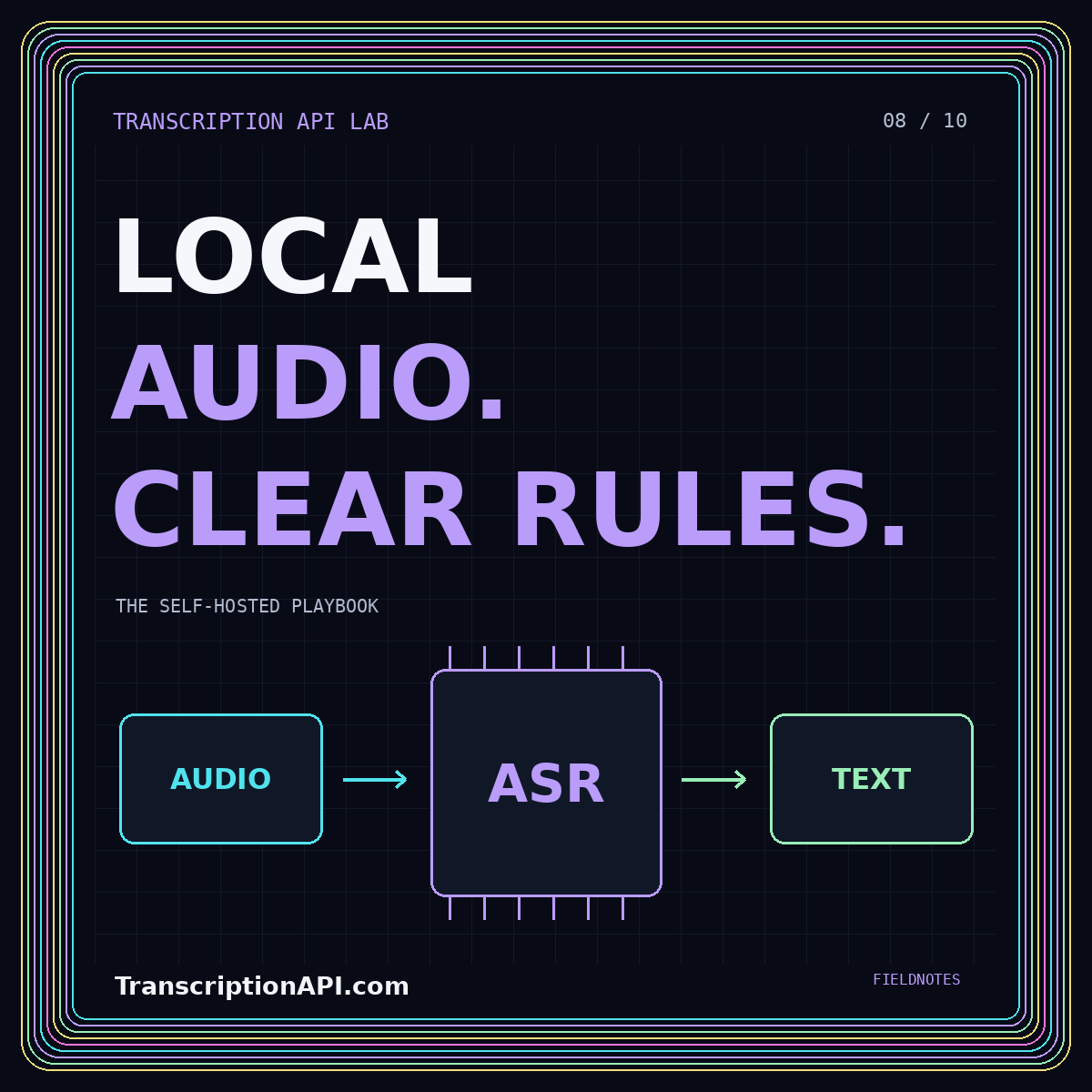
Separate local recognition from language processing, measure capacity, and map every storage and network boundary.
Read the field guide
Use a transparent hypothetical model to compare recognition, retries, storage, and the time spent reviewing results.
Read the field guideHave a correction, a topic suggestion, or a workflow worth exploring?