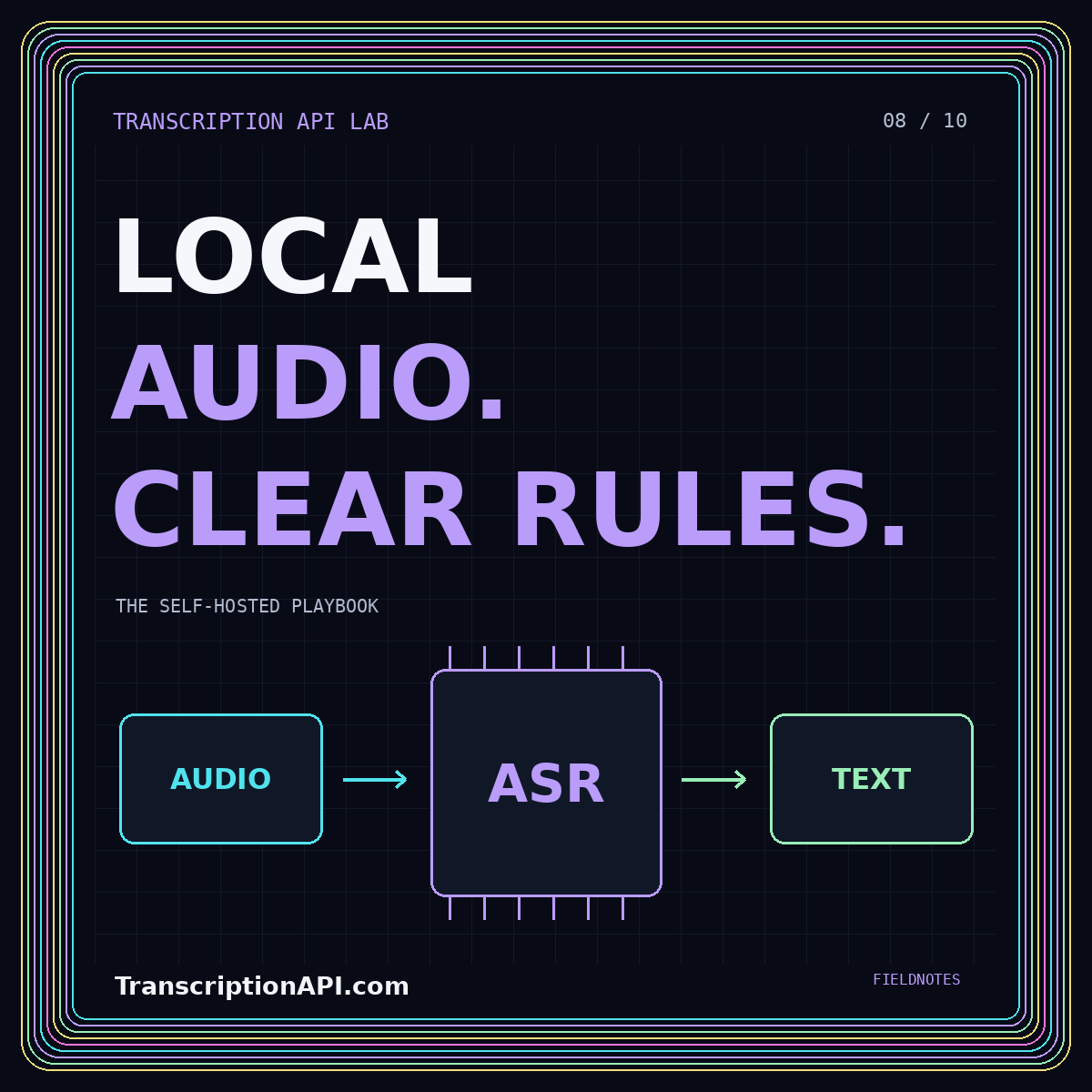
Local LLM transcription API deployment: a practical architecture
Separate local recognition from language processing, measure capacity, and map every storage and network boundary.
Read the field guide08 / SELF-HOSTED SYSTEMS
Keep the pipeline local.
Keep the boundaries clear.
A local transcription workflow can combine an audio recognizer, optional language-model processing, and an application that manages jobs and permissions. Decide which components run where. Local inference is an architecture choice, not an automatic guarantee of privacy, speed, or unlimited capacity.
Read the complete field guideAn audio-capable recognition component produces the transcript. A language model may then summarize or answer questions about that text. Keep the output of each stage distinct so a later error can be traced to recognition, editing, or interpretation.
The whisper.cpp project documents a local C/C++ recognition runtime and example applications. Pin the version and model you evaluate, and check the documentation for that deployment. Example availability does not establish performance on your own machine.
Measure model loading, decoding, recognition, serialization, and any later text processing. Test the expected concurrency and record the hardware and settings. An archive job with an overnight window has different requirements from interactive dictation.
Put durable job handling around expensive processing. Test crashes, full storage, and restarts. Keep a rollback path when changing runtimes or models, and retain approved transcript versions rather than silently rewriting them during an upgrade.
Trace recordings, model downloads, transcripts, logs, backups, and any external language-model requests. A local recognizer can still be part of a workflow that sends information elsewhere. Verify the actual data path before making a privacy claim.
Protect the application interface with appropriate access controls and input limits. Keep permanent credentials out of browser code. Budget for maintenance, hardware capacity, review, and storage rather than describing local inference as cost-free.
Primary reference: whisper.cpp project documentation. Provider-specific details should be checked against the version and configuration you use.
MAKE THE CHOICE EXPLICIT
Establish a reproducible local runtime and a representative test set.
Add a bounded text task with traceable sources and a separate review state.
Test capacity, recovery, access controls, and the intended offline behavior.
Not merely from its filename. The pipeline needs a component that processes the actual audio. A text-only model can work on the resulting transcript.
No. Inspect storage, logs, backups, telemetry, and downstream requests. Privacy depends on the whole application and its operating practices, not just the location of inference.
KEEP EXPLORING
Separate local recognition from language processing, measure capacity, and map every storage and network boundary.
Read the field guide
Design source-linked answers, permission-aware retrieval, and an explicit boundary between speech and action.
Read the field guide
Verify names, quantities, speaker assignments, uncertainty, and the final export before approving a transcript.
Read the field guideHave a correction, a topic suggestion, or a workflow worth exploring?