An AI transcriber can produce a readable draft that still needs careful checking before it becomes a public or operational record. Review is not simply a final spellcheck. It is the process of deciding whether the words, speaker assignments, and important details are supported by the recording, and whether the document is appropriate for its intended use.
This guide proposes an editorial review workflow for individual transcripts. It is different from evaluating a model across a test collection: the question here is whether this particular recording and transcript are ready for the next step. The AI Transcriber guide introduces the role of review; this article turns that role into a practical sequence with clear handoffs.
Establish the purpose and release threshold
Before opening the transcript, identify its destination. Is it a private draft, a searchable internal record, a public interview, or material used in a consequential decision? Define the required review depth and who can approve release. A single “complete” status is too vague when one person means machine processing has finished and another means every quotation has been verified.
Write a short review brief for the recording. Include its title, source version, expected language, known participants when legitimately established, and any special terminology supplied by the content owner. Do not include guesses about a person's identity or background based on their voice. The brief should help reviewers check evidence, not steer them toward a preferred interpretation of ambiguous speech.
Preserve the machine draft
Keep the original recognition output and create a separate reviewed version. Record the model or provider configuration where available. This allows a later investigation to distinguish a recognition error from an editorial change. It also preserves the material needed for future evaluation without treating a heavily rewritten reading transcript as though it were a literal reference of the recording.
Use explicit states such as draft, in review, unresolved, and approved within your own application. These are proposed workflow labels, not standardized API statuses. Define who can move a record between them. If a reviewer discovers that the recording is incomplete, the next action may be to request a better source rather than attempting to repair the transcript through confident rewriting.
Review the recording, not just the prose
Microsoft's speech-to-text transparency note describes limitations associated with acoustic conditions, language configuration, and recognition errors. It recommends evaluating the technology for the intended use and setting appropriate expectations. These provider-specific limitations support a general editorial precaution: fluent output should still be checked against the source rather than accepted because it reads smoothly.
Listen while reading, using a pace that lets you compare the two. Inspect passages that sound unclear or contain unusually polished wording over weak audio. Avoid filling gaps from what would make sense in the conversation. When the recording does not support a confident correction, mark the uncertainty and its location. An honest unresolved interval is better than an invented completion.
Check names, quantities, and negation
Give important names, identifiers, dates, and quantities a deliberate second look. A minor-looking character change can alter the meaning of an otherwise accurate paragraph. Compare the transcript with the recording and any legitimate supporting material supplied for the task. Record the basis for a correction when it is not obvious from the audio alone.
Check words that change a statement's force: not, might, could, unless, before, and after. Preserve uncertainty and conditions rather than simplifying them away. Create examples in your team's style guide showing the difference between a harmless formatting change and a meaning-changing edit. Reviewers then have a shared basis for decisions instead of relying on individual preferences for polished prose.
Verify speaker assignments separately
Read through the transcript once with attention to who is speaking. Replay short interruptions and transitions where labels may be wrong. Do not assume that correct wording implies correct attribution. A sentence assigned to the wrong person can be more consequential than a misspelled ordinary word, particularly when the transcript will be quoted or used to document responsibilities.
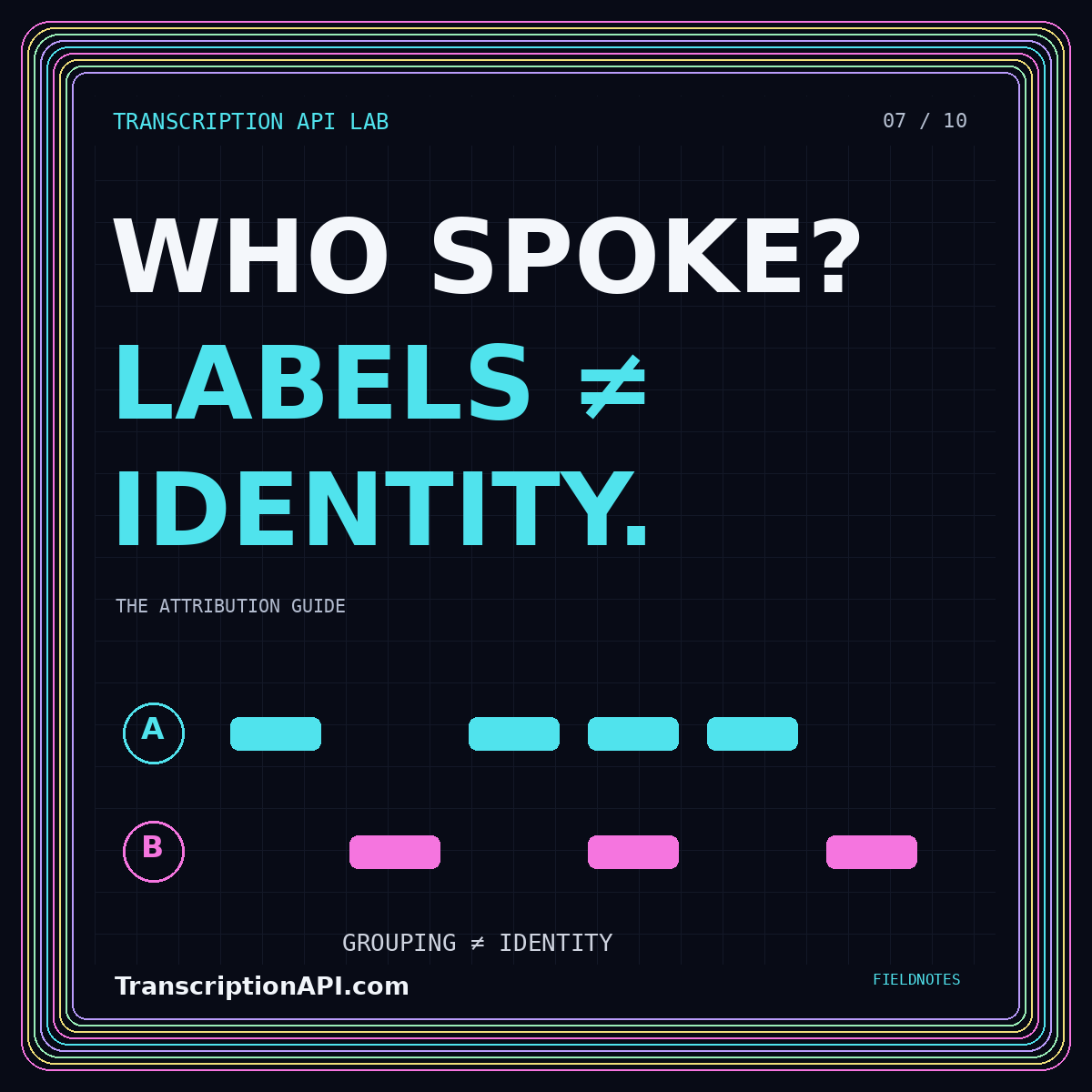
Keep anonymous speaker groups distinct from confirmed names. Let a reviewer correct one turn without changing every occurrence of a display name. When a name remains unconfirmed, retain a neutral label. The speaker diarization article explains why recognition, channel information, speaker grouping, and identity should remain separate fields in the underlying record.
Use uncertainty markers consistently
Choose a documented notation for unclear words, overlapping speech, and missing audio. Make it easy for reviewers to flag the relevant interval without inventing a replacement. The public presentation can use a reader-friendly form, but the internal record should retain enough timing information to return to the source. Avoid a mixture of unexplained brackets, question marks, and editorial guesses.
Assign unresolved items to a person who can legitimately help. A content owner may confirm a specialized spelling; a better recording may resolve a missing passage. Neither route should be used to rewrite what was actually said into what someone wishes had been said. Keep a distinction between correcting transcription and issuing a later clarification of the underlying statement.
Apply the agreed editorial style
Once the words and attribution are checked, apply formatting consistently. Group speech into readable paragraphs and use the agreed policy for fillers, false starts, and repetitions. Preserve the relationship between the reviewed transcript and the original. A reading version may be lightly edited, but it should not silently become a summary or an interpretation presented as verbatim speech.
Add headings only when they help navigation and do not claim an unsupported conclusion. Clearly distinguish editorial context from quotations. For a transcript associated with video, identify any additional descriptive material the audience needs. The text-to-words guide explains how a transcript, a summary, a translation, and a descriptive transcript serve different purposes.
Review sensitive information before sharing
Consider who is permitted to see the recording and the transcript, and whether the destination matches that permission. Check the specific material rather than assuming that an automated redaction feature found everything. Keep review copies and comments in the intended workspace. A correction process should not unnecessarily spread private speech into unrelated tickets, messages, or unrestricted logs.
Define how approved redactions appear in the public record and how the protected original is handled. Do not promise that removing a name alone makes a conversation anonymous; surrounding details may still matter. Where legal or organizational obligations are involved, route the decision through the appropriate qualified process rather than treating this editorial checklist as a substitute for that review.
Check exports and derived content
Inspect the exact files and pages that will be published. Confirm that the correct transcript version appears, speaker names match, and links point to the intended recording. Test characters, paragraph breaks, and long passages in each destination. A reviewed document can still become misleading when an export drops a negation, truncates a sentence, or associates text with the wrong media version.
Review summaries and action lists derived from the transcript separately. They may contain interpretations that were never part of the spoken material. When a correction changes an important fact, mark related outputs for regeneration or manual review. Approval of the transcript should not automatically approve every downstream use, especially where an application proposes an action rather than merely displaying information.
Close the review with a clear record
Record the approved version, approval time, reviewer role, and any remaining limitations according to your team's process. Keep the publication decision distinct from the machine completion event. When a correction arrives after release, preserve the earlier version and document the change. This gives readers and operators a way to understand which record was available at a particular point.
Use recurring errors to improve the workflow. If reviewers repeatedly fix the same type of identifier, add a targeted check. If a capture problem keeps making speech unclear, improve recording guidance. Do not assume every issue requires a new model. A short, maintained review checklist can be more useful than a long policy document that no one applies to actual recordings.
Conclusion: approval means checked for a purpose
A strong review process preserves the machine draft, verifies the recording, handles uncertainty, and checks the final destination. It makes clear who approved what and for which use. Keep the process proportionate to the consequences of error, but never confuse fluent output with verified evidence. The goal is a transcript people can rely on within a clearly understood scope.