Choosing an AI transcription API by listening to one polished demonstration is like choosing a database after running one query. The example may be genuine, but it does not describe your workload. A useful evaluation begins with recordings that resemble the audio your users actually produce, an agreed reference transcript, and a decision about which mistakes matter most to the product.
The aim is not to crown a universal winner. It is to learn whether a particular configuration meets a specific requirement at an acceptable operational cost. This article proposes an evaluation process you can repeat as models, recordings, and product expectations change. The AI Transcription API guide provides the broader context; the method here focuses on building evidence before deployment.
Begin with the consequence of an error
Write down the transcript's intended role. A search index can sometimes tolerate an imperfect sentence while still helping someone find a recording. A published quotation needs much closer checking. A task involving a person's rights or wellbeing needs a separate, appropriately qualified review process. Do not allow a convenient aggregate score to obscure those differences in consequence.
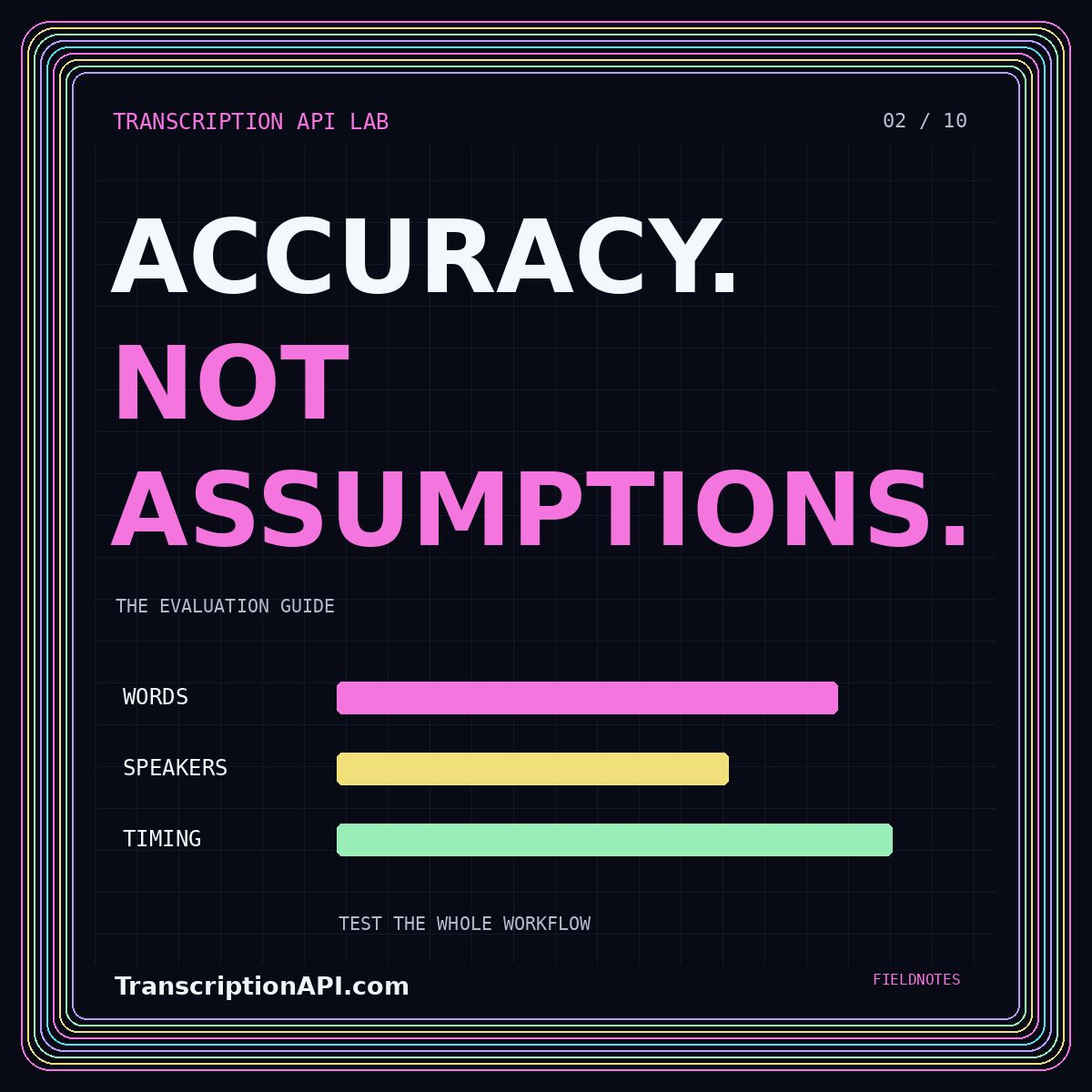
Create several error categories before testing. Useful categories might include omitted speech, invented speech, incorrect names, changed numbers, broken speaker assignments, and incorrect timestamps. These categories are your product's evaluation rubric rather than universal weights. Ask the people who use the transcripts to identify examples of unacceptable mistakes. Their examples can reveal requirements that a purely technical test would miss.
Assemble a representative test collection
Select recordings across the conditions your product expects: different microphones, room acoustics, speaking styles, languages, and conversation lengths. Include difficult but legitimate examples instead of quietly excluding them. Keep the collection separate from any recordings used to tune prompts or vocabulary hints. Otherwise, the test may reward remembering the development set rather than generalizing to new audio.
Record how each example was selected and whether you have permission to use it. Label relevant acoustic conditions without guessing personal attributes from a voice. A small pilot collection is useful for finding integration defects, but should not be described as statistically representative of all future users. Expand it deliberately when a new device, language, or use case enters the product.
Create references people can defend
Prepare human-checked reference transcripts under a written style guide. Decide how to handle fillers, false starts, contractions, punctuation, and unintelligible speech. Preserve uncertain passages as uncertain. For important evaluations, have a second reviewer inspect a subset independently and resolve disagreements. A reference is only useful when people understand what counts as a correct transcription.
Keep the reference version fixed while comparing runs. If a reviewer discovers an error in the reference, correct it openly and rerun affected comparisons. Do not edit the reference merely to make one system's phrasing look better. Store the recording, transcript version, scoring rules, and review notes together so that another team member can reproduce the assessment later.
Separate lexical errors from presentation
A common lexical measure is word error rate: substitutions plus deletions plus insertions, divided by the number of words in the reference. For a hypothetical reference containing one hundred words, five substitutions, three deletions, and two insertions produce ten percent word error rate. This is a worked arithmetic example, not a result for any provider or model.
Define text normalization before applying that measure. Decide whether case and punctuation are ignored, how numbers are represented, and how words are segmented for the languages involved. Keep the original texts alongside normalized versions. A comparison that treats “twenty one” differently from “21” can reflect formatting rather than recognition. Conversely, aggressive normalization can hide meaningful differences that your application must preserve.
Score the task as well as the text
Add checks that match the downstream use. Can a reader locate the right segment? Are important identifiers correct? Does a question remain a question? Did a negation disappear? These checks should be explicit and consistent. Do not combine them into a single weighted number unless stakeholders understand the weights and the information lost by combining distinct failure types.
Report both aggregate results and meaningful subsets. A strong average can conceal a weak result on noisy recordings or a particular supported language. Show the number and duration of examples in each subset. Avoid presenting a tiny subgroup as a definitive conclusion. Where the sample is limited, describe the observed cases and what further testing would be needed.
Look deliberately for unsupported text
The official Whisper model card documents the possibility of text that was not spoken, repetitive output, and uneven performance across languages and speaking conditions. These are limitations of that model family, not proof that every recognizer behaves identically. They illustrate why readable output alone is not evidence that a transcript is faithful to its source.
Add silence, background noise, music, interrupted audio, and very quiet speech to the test collection when those conditions are relevant. Inspect suspiciously complete sentences that appear over unclear input. Track false content separately from minor spelling differences. A transcript that confidently invents an action item creates a different product risk from one that marks a word as unclear.
Make the comparison reproducible
Record the provider, model identifier when exposed, region, request configuration, and run time. Store vocabulary hints and preprocessing settings with the result. Change one important variable at a time while diagnosing failures. Comparing different audio conversions, language settings, and models simultaneously makes it difficult to explain which change improved or harmed the result.
Measure completion time under a defined workload. Include failed requests, not only successful ones. Distinguish a cold start from a repeated run when that distinction is observable. Report the distribution rather than just the fastest example. For a live product, separately assess how soon text appears, how often interim text changes, and when the application receives a finalized segment.
Evaluate correction effort and cost together
Ask reviewers to correct a sample of outputs while recording their time and the types of edits they make. Use a consistent process and comparable recordings. Faster recognition is not automatically a cheaper workflow when its output takes longer to repair. Treat reviewer timing as an observation of this experiment, not as a guarantee about every future recording.
Build a simple cost model that includes recognition, failed attempts, storage, and review. State the assumed workload and rates rather than hiding them inside an overall score. Recalculate when those assumptions change. The transcription service cost guide develops that approach in detail, including a hypothetical comparison where review labor changes the apparent advantage of a lower recognition price.
Turn findings into release rules
Translate results into actions. A configuration may be acceptable for a private draft but require review before public use. A supported language may need more testing before it is enabled broadly. A recurring failure on clipped recordings might call for input validation rather than a different model. Assign an owner and a next step to each important failure category.
Keep a compact regression collection containing previously troublesome recordings. Rerun it before changing models, conversion settings, or output normalization. Add new real-world failures through an appropriate permission and retention process. Record why a change was approved, what improved, and what remained uncertain. Evaluation then becomes a maintained engineering practice instead of a one-time purchasing exercise.
Conclusion: prefer evidence you can rerun
A trustworthy evaluation makes the workload, references, settings, and acceptance rules visible. It measures meaningful mistakes, includes failures, and does not confuse fluent language with faithful transcription. Start with a bounded collection and expand it as the product grows. The useful outcome is not an impressive number; it is a repeatable decision about where the system can help and where people must still verify its work.