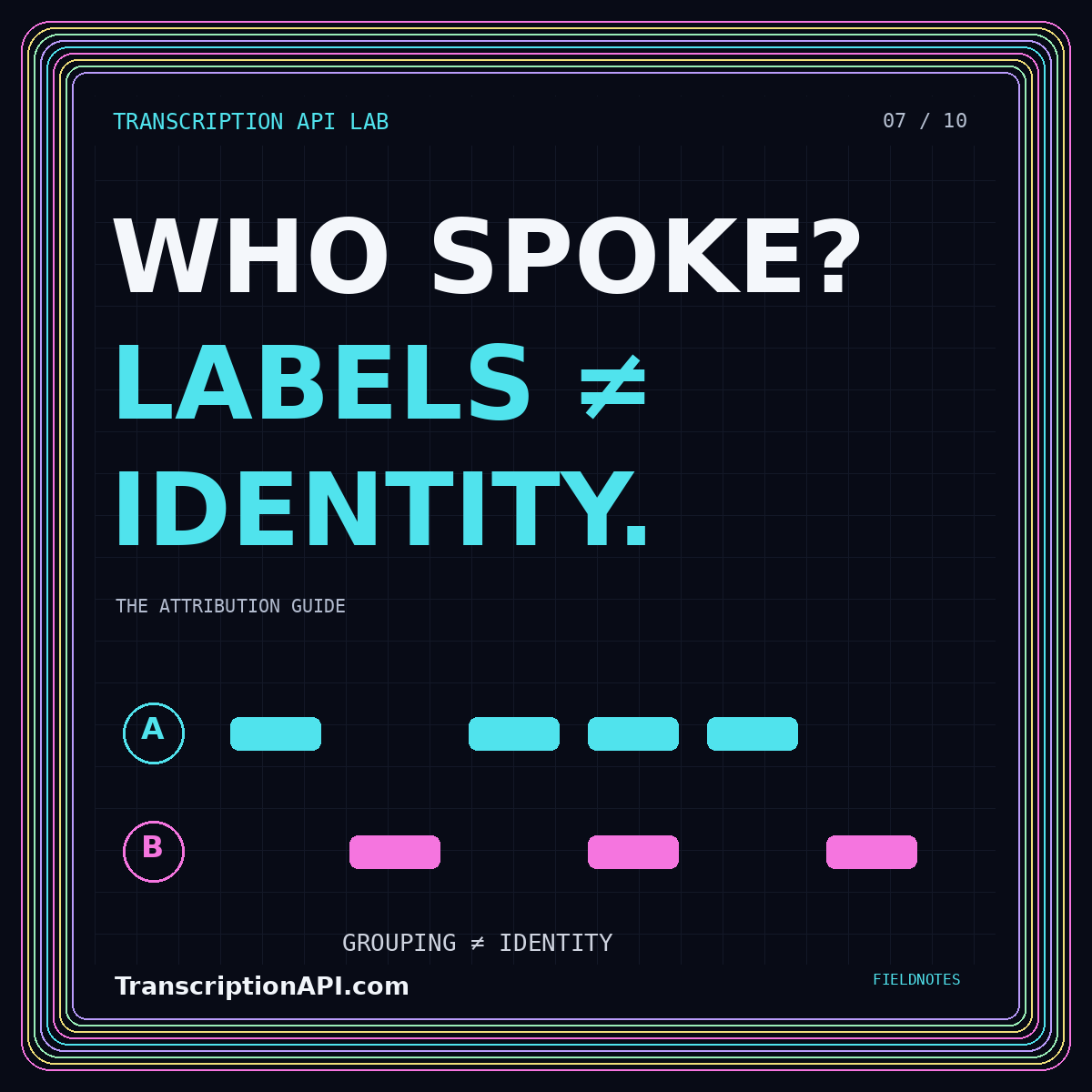
Speaker diarization for voice transcription: labels are not identities
Keep recognized words, audio channels, anonymous speaker groups, and confirmed participant names separate.
Read the field guide07 / SPEAKER ATTRIBUTION
Know what was said.
Don’t guess who said it.
Speech recognition, speaker diarization, and identity verification answer different questions. Keep those questions separate. A useful speaker-labeled transcript makes attribution inspectable without turning an anonymous voice grouping into an unsupported personal identity.
Read the complete field guideRecognition provides text. Diarization groups stretches of speech by speaker. A confirmed participant name requires its own evidence. Store these outputs in separate fields so that a correction to one turn does not silently change an identity mapping throughout a recording.
Google’s diarization documentation describes numeric speaker labels and word-level labeling for its service. Treat label meaning and update behavior as provider-specific. Inspect whether results are cumulative or incremental before appending them to a transcript.
Preserve time boundaries and a stable source version for each turn. Keep channel identifiers separately: a channel is not necessarily a person. Inspect recording routing before discarding channels or mapping them to names.
Include interruptions and overlapping speech in review. Give editors a way to mark unresolved attribution rather than selecting the most frequent speaker by default. A tidy display should not erase uncertainty present in the recording.
A new processing run can produce different anonymous labels. Recheck mappings before transferring confirmed names into a revised result. Keep editorial identity evidence scoped to the recording and reviewed version where it was established.
Evaluate speaker assignment independently from word accuracy. Inspect the final transcript and caption exports for matching labels, correct ordering, and useful source links. A schema alone cannot catch every rendering or publication error.
Primary reference: Google Cloud speaker diarization documentation. Provider-specific details should be checked against the version and configuration you use.
MAKE THE CHOICE EXPLICIT
Use neutral labels and preserve their scope within the result.
Inspect capture routing before treating channels as participants.
Record reviewed mappings and recheck them when results change.
Not by itself. An anonymous speaker grouping does not establish a name or verify identity. Keep confirmed participant metadata separate from recognition labels.
Do not assume labels remain stable between results. Review mappings against the actual recording before applying previously confirmed names to a new result.
KEEP EXPLORING
Keep recognized words, audio channels, anonymous speaker groups, and confirmed participant names separate.
Read the field guide
Verify names, quantities, speaker assignments, uncertainty, and the final export before approving a transcript.
Read the field guide
Build a caption-export pipeline with stable segments, timestamp validation, playback review, and media version checks.
Read the field guideHave a correction, a topic suggestion, or a workflow worth exploring?