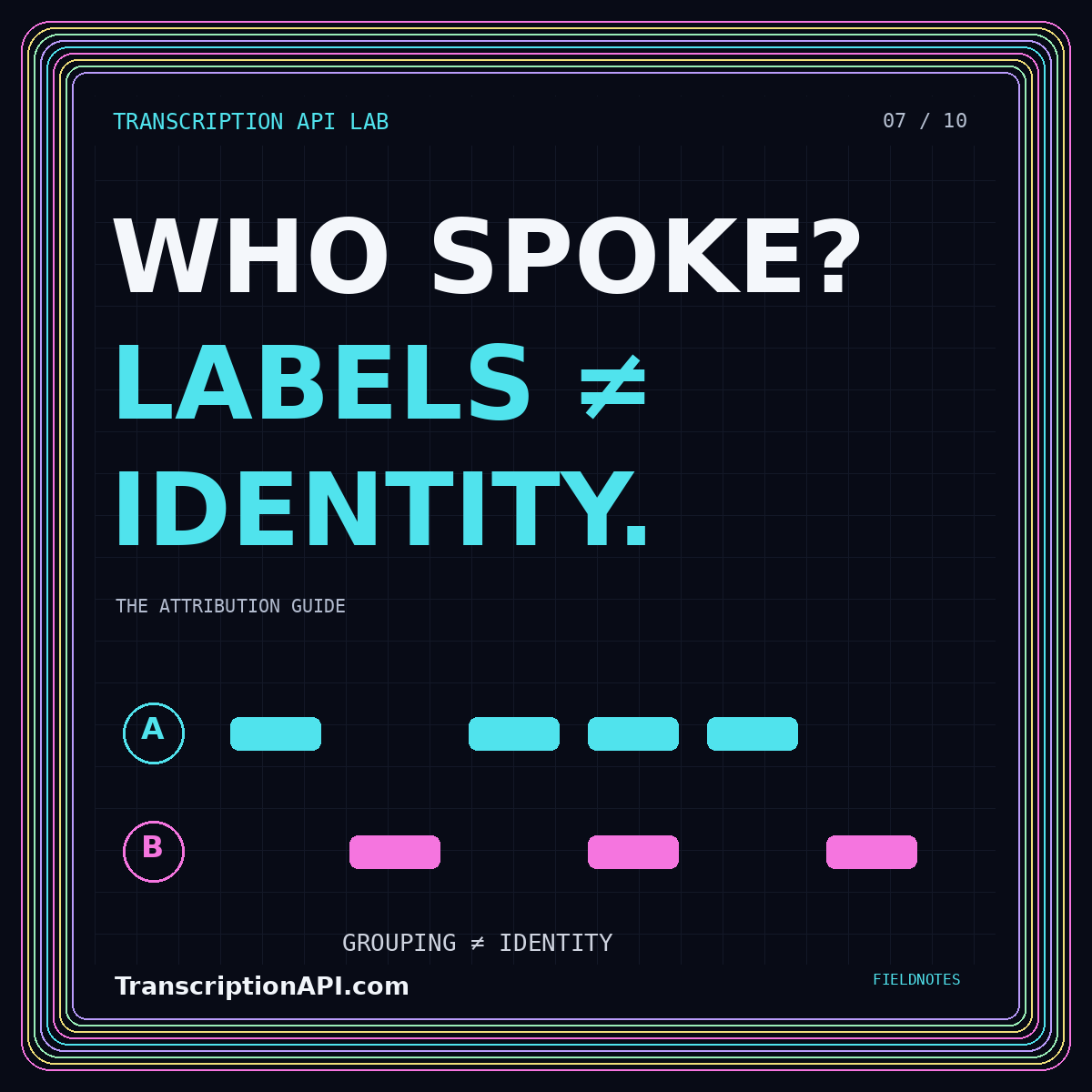
A transcript can contain the correct words and still misrepresent a conversation when those words are assigned to the wrong speaker. Speaker diarization addresses the grouping of speech by speaker over time. It does not, by itself, establish a person's name or verify their identity. That distinction should shape both the data model and the labels people see in your application.
This guide proposes a careful implementation for recorded conversations. It focuses on separating recognition, speaker grouping, channel information, and confirmed participant metadata. Start with the Voice Recognition Transcription API overview for the terminology. The design recommendations here are intended to make errors visible and correctable, not to promise perfect attribution in every recording.
Separate three different questions
The first question is what was said. The second is which stretches of speech seem to belong to the same speaker. The third is whether that speaker corresponds to a particular person. A transcription system may answer the first, provide a grouping for the second, and have no legitimate evidence for the third. Avoid collapsing those outputs into one confident-looking name field.
Use separate fields for recognized text, diarization label, channel identifier, and confirmed display name. A neutral label such as Speaker A can remain useful even when no name is known. If an editor later confirms a participant, store that mapping with its scope and review status. Do not imply that an anonymous label automatically follows the same person across unrelated recordings.
Understand provider output before normalizing it
Google's speaker diarization documentation describes assigning numbered labels to detected speakers and attaching labels to recognized words. It also explains that its diarized results can include a running aggregate of previous words. Those details are specific to the documented service behavior and show why an adapter must understand whether incoming data is cumulative or incremental.
Inspect a complete response from your chosen configuration. Determine whether labels arrive at word or segment level, whether they can change during processing, and how the final result is identified. Do not append every update to a permanent transcript without understanding those rules. A cumulative response treated as an increment can duplicate words even though the provider returned a valid result.
Build turns from timed speech
A useful internal turn record contains a stable identifier, start and end times, speaker label, text, and the source transcript version. Create turns by grouping compatible adjacent segments under a documented rule. Keep the original word or segment data available for later correction. Turn construction is an application transformation, not proof that the underlying grouping is correct.
Decide how your renderer handles a pause, an interruption, and a return to the same speaker. Do not force every nearby segment into a single paragraph merely because its label matches. A conversation may be easier to follow when a long pause or a topic change creates a new turn. Keep these presentation choices distinct from changes to the recognized words.
Do not confuse channels with people
A channel is a property of the recording or capture path. It may carry one participant, several participants, or the same mix as another channel. Before using channel information for attribution, inspect how the recording was produced and listen to each channel. Preserve the original routing metadata rather than replacing it with an assumed participant name.
For a call with separate input channels, channel-aware processing may be worth testing alongside diarization. The appropriate choice depends on the source and the selected service's capabilities. Do not mix channels automatically before you have considered their value. The voice audio-quality guide develops a repeatable inspection process for these intake decisions.
Treat overlap as a first-class review case
When two people speak at once, a tidy sequence of non-overlapping turns may hide uncertainty rather than resolve it. Include overlapping speech in your test collection. Inspect whether words are omitted, whether two voices are merged, and whether labels remain coherent afterward. Do not judge attribution only on recordings in which every participant politely waits for the previous sentence to finish.
Give reviewers a way to mark an overlapping or uncertain interval. Your public renderer may need a simplified representation, but the internal record should preserve the fact that the source was more complicated. Avoid guessing an attribution solely because one participant is the most frequent speaker. A short interruption can carry important meaning even when it occupies little of the total recording.
Keep label revisions manageable
Treat diarization labels as scoped to a processing result. A rerun may assign different labels to the same voices even when the transcript is otherwise similar. Compare the actual speech intervals and review mappings before carrying participant names into the new version. Assuming that Speaker 1 always remains the same participant can silently attach a correct name to the wrong voice.
Store participant mappings separately from the recognizer's raw labels. If an editor confirms several intervals, use that evidence within the reviewed version rather than overwriting the original response. When a later model result is substituted, require a mapping check. This separation makes it possible to improve recognition without losing the provenance of human attribution decisions.
Evaluate attribution independently from wording
Create a reference subset with reviewed turn boundaries and speaker assignments. Assess whether the words are correct and whether their attribution is correct as separate questions. A transcript with excellent spelling can still have unusable speaker grouping. Conversely, a recording can have coherent speaker labels while several names or technical terms are transcribed incorrectly.
Include brief speakers, long pauses, similar-sounding voices, and changes in microphone position where those conditions occur in your use case. Report observed limitations without inferring personal attributes from the voices. Keep the recording selection and review method visible. A result from a few clean interviews should not be presented as evidence that the same configuration will work for every meeting environment.
Design a correction interface around evidence
Let reviewers replay the relevant interval and adjust a turn's speaker label without rewriting its text. Offer a separate operation for changing a confirmed display name. Show unresolved mappings explicitly. These controls prevent a common source of confusion: an editor fixes a name globally when the real problem is that only one turn was assigned to the wrong speaker.
Preserve an edit history that records which turns were changed and why. Avoid exposing private participant details in general application logs. For a collaborative workflow, define who can approve attribution and who can merely suggest a correction. The appropriate permissions depend on the context, but the interface should not make every user's guess indistinguishable from a reviewed identity mapping.
Publish with appropriate confidence
Choose neutral public labels when names are unknown or unnecessary. Confirm that exported captions and reading transcripts use the same reviewed mappings. If attribution remains uncertain, mark it rather than quietly selecting a person. A clear uncertainty note is more faithful than a polished but unsupported quotation attribution, especially when the statement may be reused outside its original context.
Before release, inspect a sample of the final rendered conversation rather than only the internal JSON. Check paragraph boundaries, labels, and links back to the recording. A schema can be correct while a renderer reorders turns or carries the wrong label into a later paragraph. End-to-end review should cover the exact representation that readers will use.
Conclusion: label speech without inventing identity
Speaker diarization is useful when its scope is clear. Keep words, audio channels, anonymous speaker groups, and confirmed people separate. Understand the provider's update behavior, preserve uncertain overlap, and make corrections traceable. The result is not a promise of perfect identification; it is a conversation record whose attribution can be inspected, improved, and presented honestly.