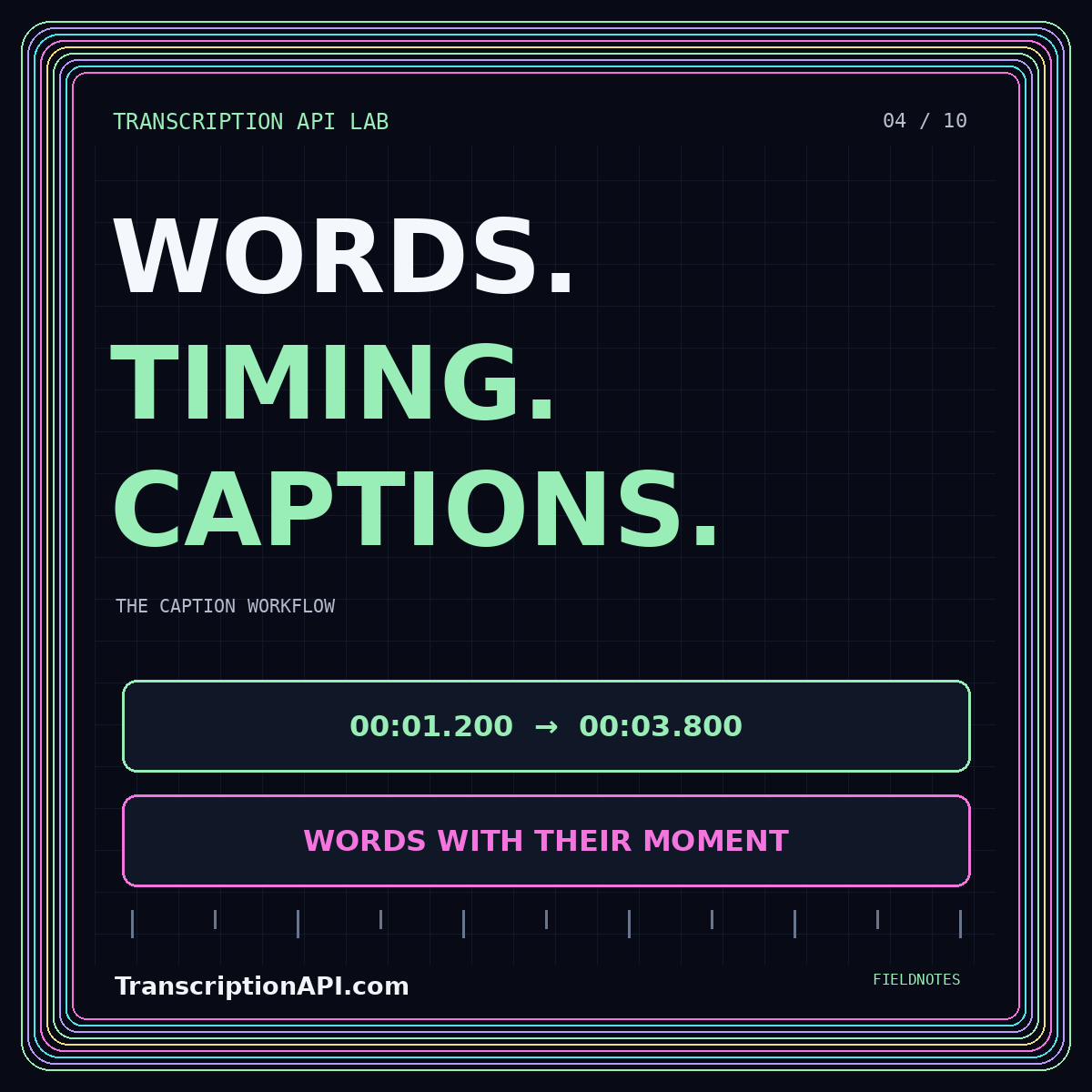
From speech-to-text API output to reviewed WebVTT captions
Build a caption-export pipeline with stable segments, timestamp validation, playback review, and media version checks.
Read the field guide04 / TEXT & TIMING
Words need context.
Captions need timing.
Speech-to-text recognition supplies a starting point for readable transcripts, captions, and searchable media. Choose the destination first. A text field, a timed caption track, and a published transcript require different validation and editorial decisions.
Read the complete field guideFor a reading transcript, prioritize coherent paragraphs and a clear connection to the source. For captions, preserve enough timing information to edit and inspect cues. Do not assume that the provider’s segment boundaries are already ideal for reading during playback.
Use one documented timing unit inside the application. Keep media identity, segment identity, language, text, and speaker labels separate. Report absent timing information honestly rather than inventing measured-looking boundaries.
WebVTT is a W3C-defined format for timed text tracks. Its structure and timing rules are distinct from the editorial work needed to make captions usable. Begin with a small, well-tested subset before adding player-specific presentation features.
Check cue ordering, start and end times, text encoding, and unexpected overlap. Test minute and hour boundaries in timestamp formatting. Keep markup-like transcript content from becoming a control sequence in the exported file.
A revised media introduction can invalidate timing that was correct for an earlier version. Associate each export with the exact media and reviewed transcript versions. Review the result in the actual player rather than only inspecting a generated text file.
Check small-screen reading, speaker changes, important sounds, and any visual information the audience needs. A successful file parse is not an accessibility certification. Assign editorial and accessibility review appropriate to the published experience.
Primary reference: W3C WebVTT specification. Provider-specific details should be checked against the version and configuration you use.
MAKE THE CHOICE EXPLICIT
Organize paragraphs, preserve meaning, and make the source easy to find.
Validate timing and review cue boundaries during playback.
Keep segment identifiers and versions for downstream tools and corrections.
No. A transcript supports reading the content; captions are synchronized with media playback. Your project may need both, and each should be reviewed for its destination.
That depends on the intended use and review rules. Keep recognition completion separate from approval, especially for quotations, caption tracks, and consequential material.
KEEP EXPLORING
Build a caption-export pipeline with stable segments, timestamp validation, playback review, and media version checks.
Read the field guide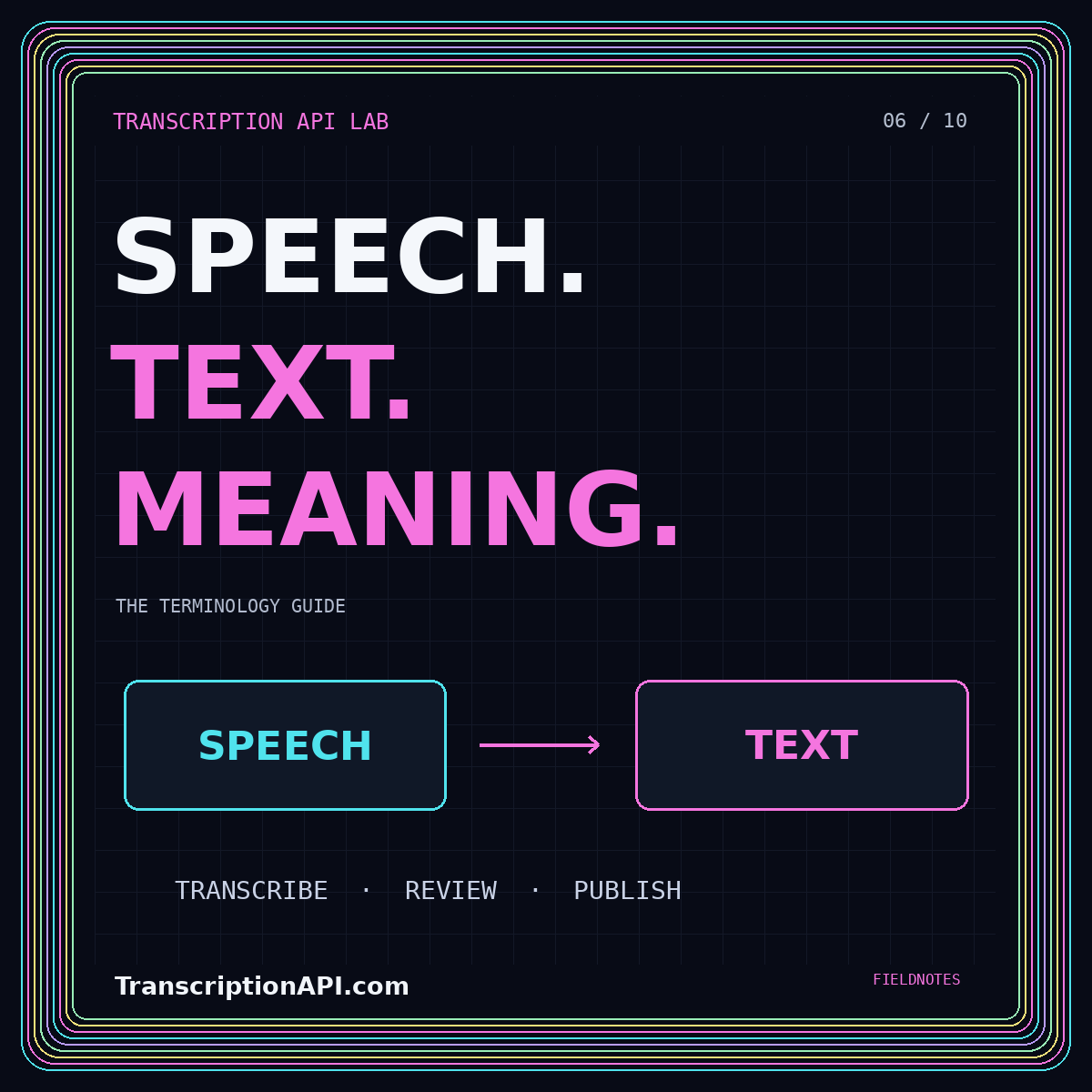
Untangle transcription, translation, summarization, and speech synthesis—and prepare a readable, faithful record.
Read the field guide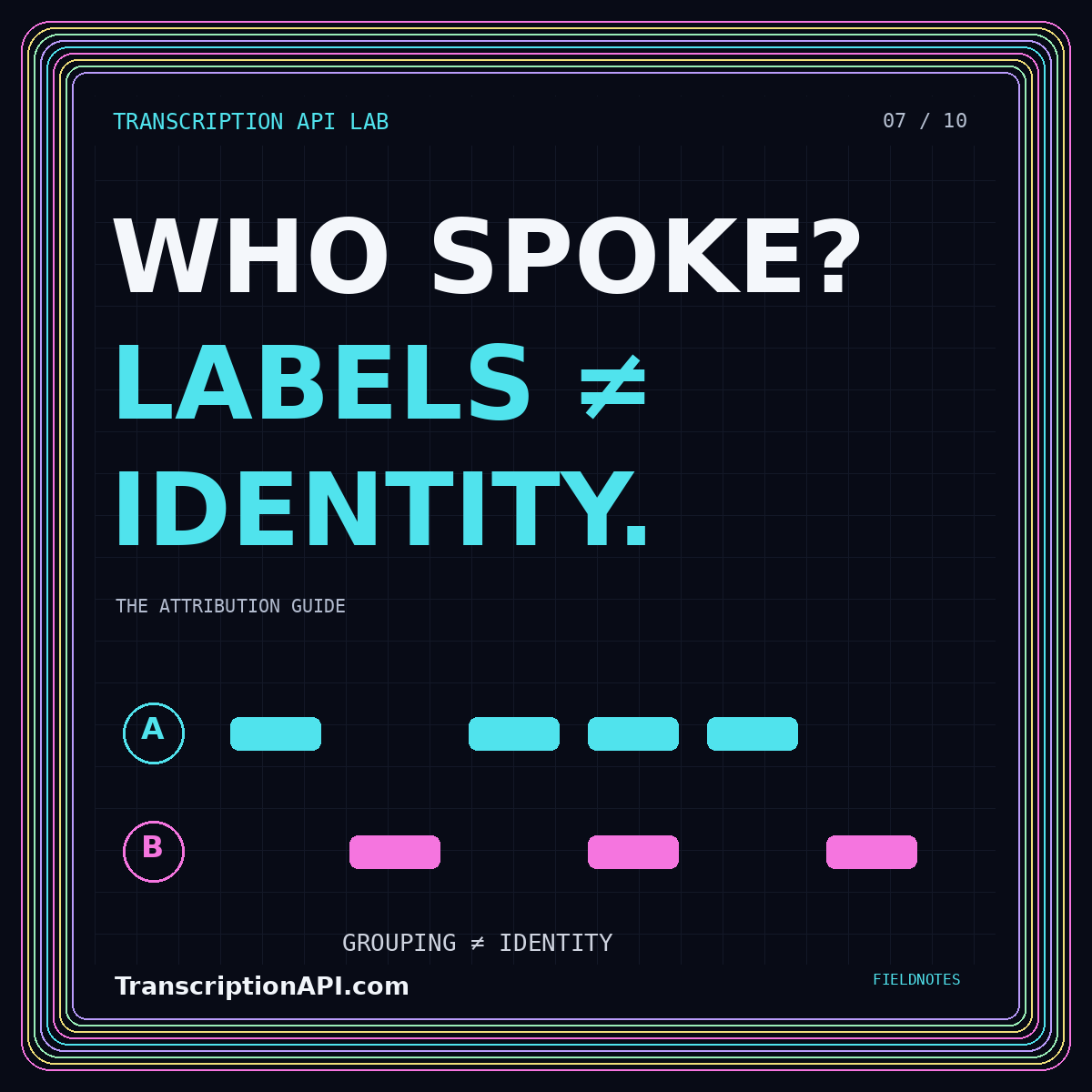
Keep recognized words, audio channels, anonymous speaker groups, and confirmed participant names separate.
Read the field guideHave a correction, a topic suggestion, or a workflow worth exploring?