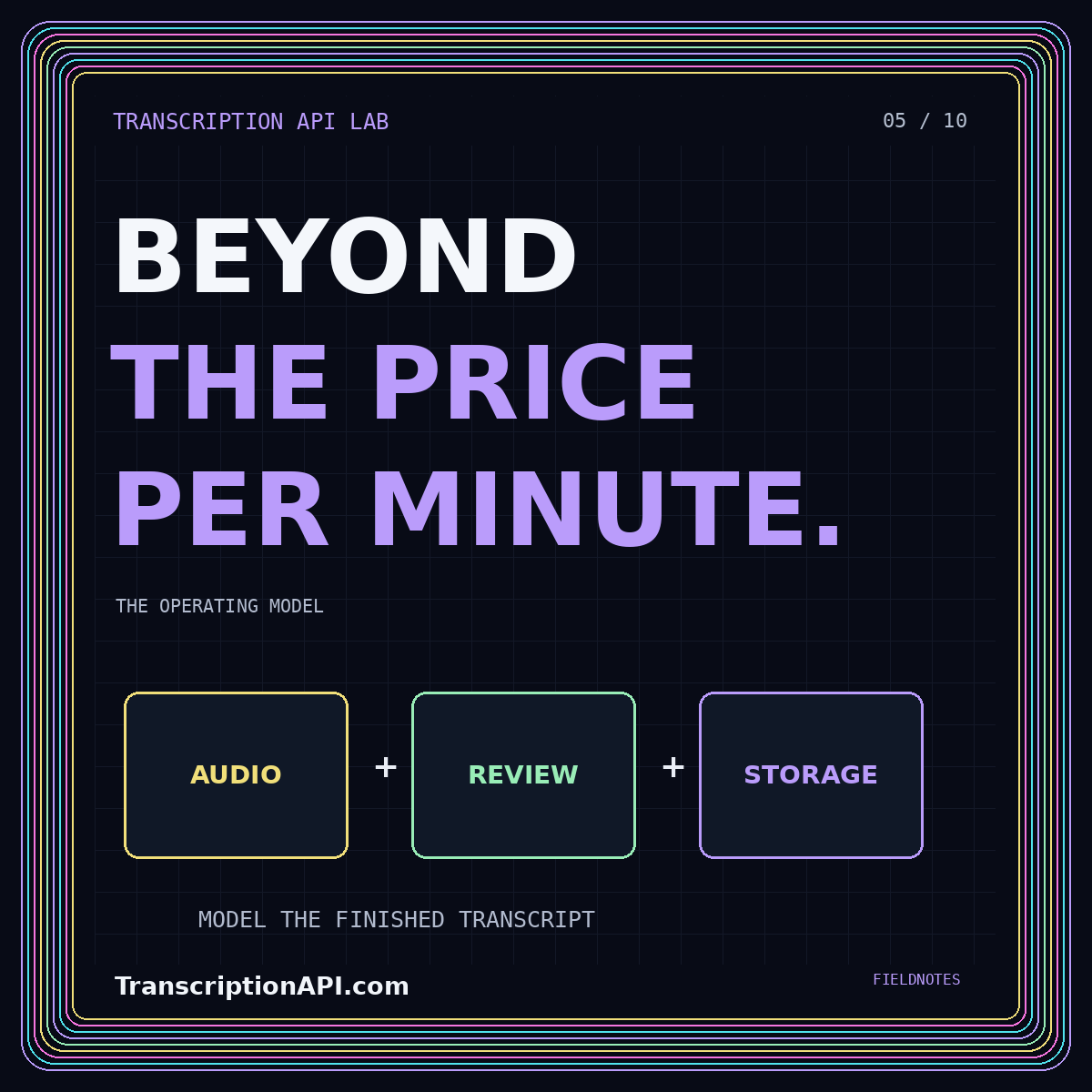
The advertised price of a transcription API service is only one input to a product budget. The application may also pay for repeated processing, media storage, exports, monitoring, and the people who correct the transcript. Comparing recognition rates without those surrounding costs can produce a decision that looks inexpensive in a spreadsheet but becomes expensive in everyday operation.
This guide builds a transparent cost model using hypothetical numbers. It is not a price list, a vendor quote, or a claim about the economics of a particular service. Replace every example assumption with your own measured workload and current contract terms. The AI Transcription API Service guide provides the wider procurement and operating checklist.
Define the unit you actually need
Start with the business unit that matters: a reviewed interview, a searchable meeting, an approved caption track, or a completed support recording. Recognition minutes are useful for billing, but they may not be the output the organization values. Keep both measures so that you can connect technical usage to the number of usable deliverables the workflow produces.
Separate submitted duration from successfully delivered duration. Failed attempts, duplicated jobs, and intentional reprocessing can make those quantities different. Record whether silent sections and multiple channels affect billing under the chosen service's rules. Do not apply one provider's interpretation to another. Your estimate should state what counts as billable usage and where that definition came from.
Read the rate structure, not just the headline
The official Amazon Transcribe pricing page illustrates why this matters: it distinguishes service modes, regional and volume-based pricing, and optional features that can add charges. Consult the applicable current terms for any service you evaluate. This article intentionally avoids quoting live rates, which can change and may not match your region, workload, or agreement.
List the assumptions next to the model. Include currency, region, billing period, recognition mode, expected volume, optional features, and any commitment. Record whether a trial or temporary credit is included. A budget that depends on a promotional allowance should show the steady-state cost separately. Otherwise, the first paid billing period can appear to be an unexpected increase even when nothing changed operationally.
Estimate workload from real recording patterns
Break the workload into a few meaningful groups. Short voice notes, long interviews, and live sessions can have different duration distributions and review needs. Estimate the number of recordings and their duration separately rather than multiplying one convenient average across everything. Keep a low, expected, and high scenario when the future workload is uncertain.
Use posted usage from a pilot when it becomes available, but document the pilot's limitations. A test week during a quiet period may not represent a launch or seasonal peak. Distinguish observed volume from planned growth. Do not turn an aspirational adoption forecast into a measured fact. The model should make it easy to update one assumption without rewriting every calculation.
Add retries and deliberate reprocessing
A useful first formula is submitted minutes multiplied by the recognition rate, plus separately billed features. Then add the expected processing overhead from retries and reruns. Make the overhead explicit. For example, a five percent reprocessing assumption means that a planned ten thousand minutes of source audio would produce ten thousand five hundred submitted minutes in this simplified model.
That five percent is hypothetical, not a recommended industry benchmark. Replace it with observed data once your system is operating. Separate avoidable duplicate submissions from intentional quality reruns. The first may be reduced through better job handling; the second may be a product requirement. The integration architecture guide explains why durable job identity helps you distinguish those cases.
Include the cost of review
Measure review time on representative recordings using a consistent process. Record whether reviewers merely check flagged passages, correct the full transcript, or prepare a publication-ready deliverable. These activities should not share an assumed rate of effort. Include the time needed to resolve unclear names, verify quotations, and correct speaker labels when those tasks are part of the product.
Use a fully stated labor assumption. In a hypothetical example, twenty review hours at thirty dollars per hour cost six hundred dollars. The hourly figure is an example input, not a wage recommendation or market estimate. Include any additional operational overhead that your budgeting method requires, but do not hide it inside an unexplained multiplier that readers cannot audit.
A worked comparison with invented numbers
Suppose two configurations each process ten thousand minutes in a month. Configuration A has an assumed recognition rate of one cent per minute, while configuration B has an assumed rate of two cents. Their recognition costs are therefore one hundred dollars and two hundred dollars. This comparison deliberately ignores volume tiers and other billing rules to keep the arithmetic visible.
Now suppose a controlled pilot suggests twenty hours of review for A and twelve hours for B at the same assumed thirty-dollar hourly cost. A totals seven hundred dollars for recognition and review; B totals five hundred sixty dollars. B is less expensive under these particular assumptions, despite its higher recognition rate. That is an illustration of model sensitivity, not evidence that a more expensive recognizer always reduces review.
Account for storage and supporting services
List the assets you retain: original recordings, processing copies, raw recognition responses, corrected transcripts, and export files. Record their retention periods and approximate sizes. Include backup and data-transfer charges where they apply to your architecture. A transcript may be small, but retaining several copies of long recordings can dominate the storage assumptions you originally made for text alone.
Add monitoring, job queues, and any compute used for conversion or local inference. Keep fixed and usage-dependent costs separate. A system operated on existing hardware still consumes capacity and maintenance time, even when no new invoice arrives for each recording. Conversely, do not allocate the entire cost of shared infrastructure to transcription unless that reflects your organization's actual accounting method.
Compare cloud and local operation consistently
A local recognizer replaces some usage charges with hardware, energy, maintenance, and capacity decisions. Compare the same deliverable, quality threshold, and review process on both sides. Include the effort required to deploy updates, diagnose failures, and protect stored recordings. Do not label local inference free simply because the model can be downloaded without a per-minute recognition charge.
Model utilization carefully. Hardware sized for a peak may sit idle during quiet periods, while a smaller machine may create a queue when many recordings arrive together. State the acceptable completion window and estimate how the workload fits it. The local transcription deployment guide develops this operational question without promising a universal hardware configuration.
Make the estimate useful after launch
Tag jobs with a project, environment, and processing purpose so that usage can be reconciled. Development experiments and customer production traffic should be distinguishable. Review unexpected changes in submitted duration, rerun frequency, and review time before assuming that a rate changed. Often, the most actionable finding is a workflow change rather than a different price schedule.
Set a review cadence for the model and record who owns each assumption. Compare the estimate with actual invoices and completed deliverables. Explain discrepancies instead of silently changing the forecast to match the outcome. Over time, this creates a more useful operating record than a single attractive cost-per-minute figure copied from a vendor's public pricing page.
Conclusion: budget for usable output
A defensible transcription budget connects source duration, billing rules, processing overhead, supporting infrastructure, and review effort. It labels hypothetical inputs and keeps calculations visible. Start with a simple model, then replace assumptions with observations from your own workflow. The relevant question is not only what recognition costs, but what it takes to deliver a transcript people can reliably use.