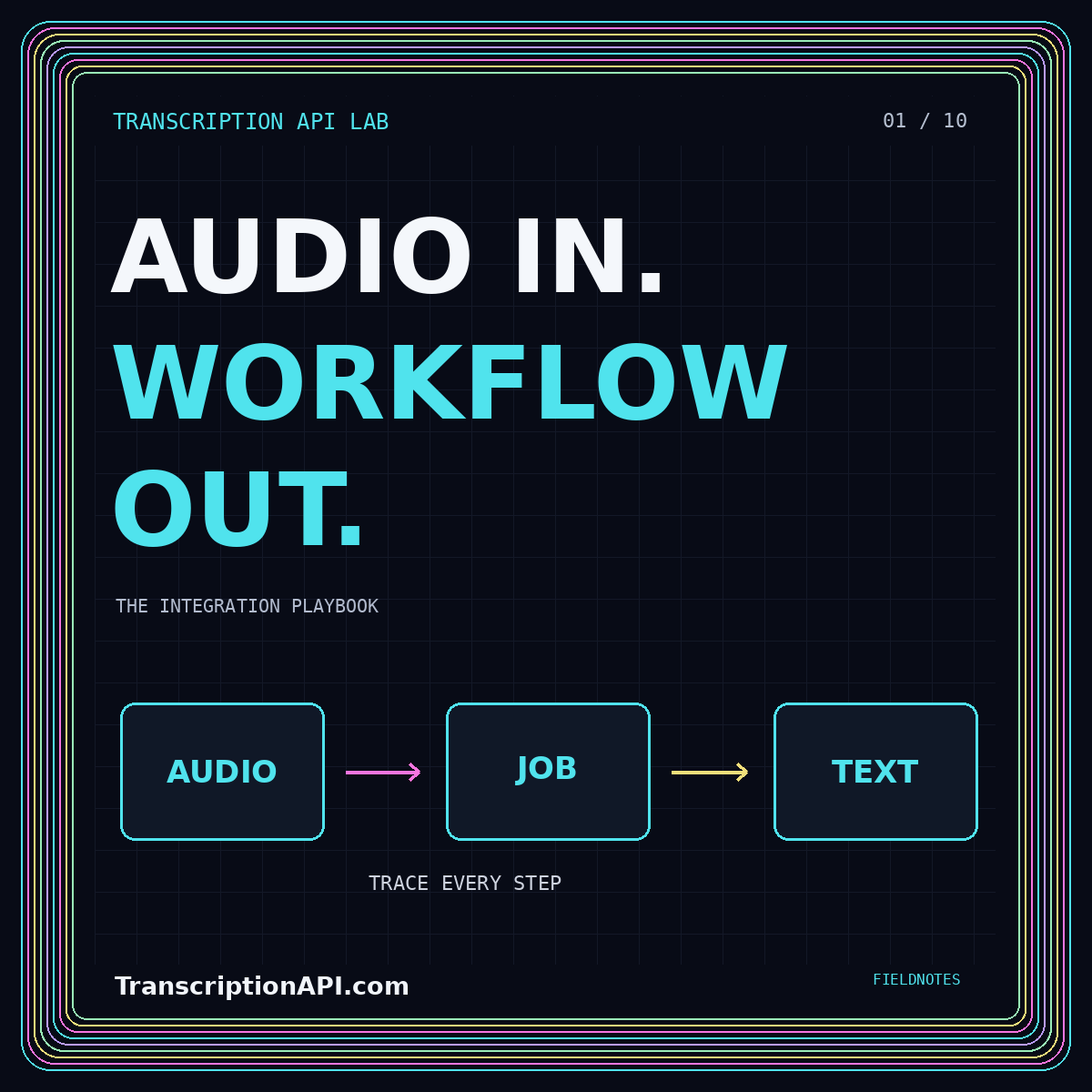
A transcription API integration is not finished when a sentence appears in a response. It is finished when your application can explain which recording produced that sentence, recover from an interrupted job, and let someone correct the words without losing the original result. Treat speech recognition as one component in a larger information workflow, rather than as a replacement for that workflow.
This guide develops a practical starting architecture for recorded audio. The proposed data structures and decisions are design recommendations, not documentation for a TranscriptionAPI.com endpoint. Use them to prepare an implementation with your chosen provider. Begin with the Transcription API overview for terminology, then work through one representative recording before expanding the integration to a complete archive.
Define the output before choosing the request
Ask the person consuming the transcript what they need to do next. A searchable interview needs readable paragraphs and a link back to the recording. A subtitle workflow needs timing information. A conversation analysis tool may need speaker boundaries. These are different contracts, even when they begin with the same audio file. Record the required fields and the acceptable fallback when a field is unavailable.
Write a small acceptance example by hand. Include an asset identifier, language, transcript text, and processing state. Add timed segments only when there is a downstream use for them. Decide whether punctuation changes should count as a new transcript version. Avoid promising that every provider will return the same information; an adapter should explicitly report unsupported fields instead of supplying invented values.
Choose a completion model
An API can return a result within one request, accept a job for later collection, or exchange audio and results while a session is open. These are not interchangeable experiences. Google's Speech-to-Text overview documents synchronous, asynchronous, and streaming recognition, including the distinction between interim and final streaming results. Treat that as a provider-specific example, not a universal interface specification.
For an archive importer, prefer a durable job model in your own application. A job can outlive a browser tab, network connection, or worker process. For a live interface, define what viewers see before a result becomes final. Do not select streaming solely because it sounds faster: a file-processing task may benefit more from reliable queuing and predictable completion than from incremental text.
Keep recording identity separate from job identity
Give the source recording a stable asset identifier. A new recognition attempt receives a separate job identifier that points back to the asset. This distinction makes it possible to retry a failed request, compare different configurations, and retain a reviewed transcript without overwriting it. Store the media's duration and a checksum alongside the asset when your storage design supports them.
A useful job record includes the provider's request identifier, selected language, configuration version, creation time, and terminal outcome. Store failure categories rather than only a free-form error string. A decoder error and a temporary service interruption require different remedies. Be selective with logs: operational troubleshooting usually needs identifiers and timings more than it needs the complete recording or transcript.
Validate the media boundary
Before submitting audio, verify that your application can read the file and that its declared format matches the actual media. Limit upload size and duration within your own product rules. A filename ending in a familiar extension is not enough evidence. Keep the original recording when you create a processing copy so that later debugging can distinguish source problems from conversion problems.
Do not apply every available audio transformation by default. First establish a baseline using representative recordings. Then test one change at a time and inspect whether it helps the intended task. Preserve channel information until you know whether it is useful. A conversion that simplifies decoding might discard information that a later speaker or channel analysis needs.
Build a small provider adapter
Keep provider-specific request construction outside the rest of your application. The adapter should translate your selected configuration into the provider's documented fields and translate its result into your internal record. Retain the unmodified response separately when appropriate for your retention policy. That original is valuable when a normalization bug changes segment timing or drops a speaker label.
Your internal result should distinguish missing data from empty data. An empty transcript might mean no recognizable speech; a missing transcript might mean the job has not completed. Represent those states deliberately. Do not normalize all failures into an empty string and report success. Downstream systems need enough information to decide whether to wait, retry, ask for review, or stop.
An illustrative state sequence
A simple sequence is received, validated, submitted, processing, review ready, and published. Add explicit failed and cancelled outcomes. These names are an application proposal, not vendor status values. Define which transitions are permitted, and which component owns each transition. For example, a reviewer can approve a transcript, but should not silently change a job from failed to completed.
Make publication a separate operation from recognition completion. This separation allows a quality check to happen without hiding the raw output. It also gives users a more accurate status message: recognition can be complete while the transcript is still waiting for correction. A durable event history helps explain how the result moved from machine output to a user-facing record.
Design retries without multiplying work
Imagine a connection closing immediately after the provider accepts a job. Your application may not know whether submission succeeded. Keep a record of the attempt before sending it, and use provider-supported idempotency where available. Where it is unavailable, reconcile the request using documented job identifiers and your own attempt history before creating another expensive operation.
Separate transient failures from permanent failures. A temporary rate limit may justify a delayed retry; an unsupported file should go back to validation. Use bounded retry attempts with increasing delays and an overall deadline. After the limit, surface an actionable error instead of retrying forever. A manual retry should retain the previous attempt so that support can see what changed.
Keep human corrections traceable
Store the machine transcript and the corrected transcript as separate versions. Record whether a change fixes recognition, adjusts formatting, or adds editorial context. This makes future model evaluation possible: comparing new output against a heavily rewritten article would otherwise measure writing style as much as recognition quality. Preserve enough segment context to replay a disputed passage.
Assign review effort according to the consequences of an error. A private search aid and a public quotation do not need identical release rules. Give reviewers a way to mark uncertainty instead of forcing a guess. In your interface, keep an unresolved name or number visible as unresolved until someone can establish it from the recording or another legitimate source.
Test the unhappy path first
Create fixtures for a short clean recording, a long recording, silence, interrupted speech, an unsupported format, and a provider failure. Confirm that every case ends in an understandable state. Test duplicate callbacks and repeated completion events as well as successful responses. The application should not publish the same transcript twice or attach one job's result to another recording.
Measure the complete user journey: validation, upload, queuing, recognition, retrieval, and review. Do not describe recognition time alone as end-to-end completion time. Document the test machine, network conditions, media duration, and configuration. For a more demanding assessment, continue with the AI transcription evaluation guide, which separates text errors from application consequences.
Conclusion: ship a recoverable workflow
A useful first release does not need every language, export format, or live feature. It needs a clear input contract, a traceable job record, understandable failure states, and a transcript that people can verify. Start with one bounded use case and make its behavior observable. Broaden the feature set only after the original workflow remains reliable under interruptions and imperfect audio.