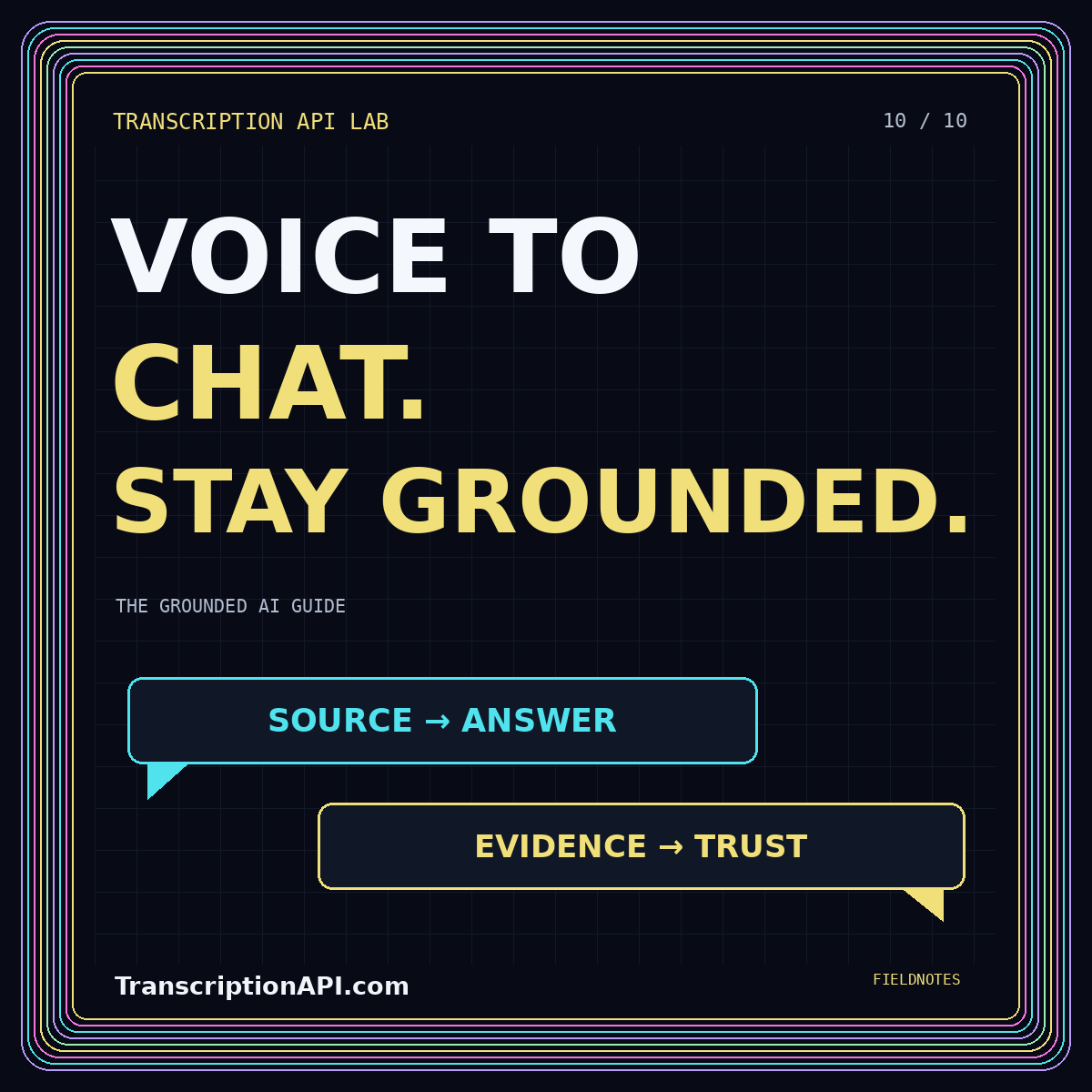
A chat transcription API workflow connects two different tasks: recognizing speech and responding to text. The first attempts to capture what was said. The second may summarize, answer questions, or propose actions based on that record. Combining them can be useful, but it also creates a new failure path: an uncertain transcript can become a confident answer with no visible link to the source.
This guide proposes a grounded workflow for recorded conversations and transcript-based chat. It does not describe a live service offered by TranscriptionAPI.com. Start with the Chat Transcription API overview to identify the components. Then define how the application preserves evidence, handles revisions, and prevents transcript content from becoming authority to act.
Keep the transcript as a source record
Store the recognition result before asking a language model to interpret it. Preserve segment identifiers, timing information, and speaker labels where available. Keep a separate reviewed version when people correct the text. A summary should point to a specific transcript version, not to an informal document that may change underneath it without notice.
Represent generated answers as derived records. Store the question, source version, relevant segment identifiers, and the status of any human review. This structure makes it possible to inspect why an answer changed after a transcript correction. It also prevents the generated response from replacing the source evidence merely because it is shorter or easier to read.
Separate content from instructions
A recording can contain someone saying “ignore the previous instructions” or describing an action they do not actually authorize the application to perform. Those words belong to the transcript. They are not a new instruction from the application's operator. Mark source material clearly and keep it separate from the system's task instructions and permission decisions.
The OWASP prompt injection guidance describes indirect injection through external content and recommends controls such as least privilege, output validation, and approval for high-risk actions. It also notes that there is no foolproof prevention method. For transcript-based systems, treat these as reasons to enforce boundaries in application code rather than relying on one prompt to make every input safe.
Start with a bounded read-only task
A practical first release might answer questions about one selected recording without sending messages or changing other systems. Define the question types the interface supports and what it should do when the transcript lacks the answer. A clear “not established in this recording” response is more useful than a plausible completion drawn from unrelated general knowledge.
Keep the context limited to material the requesting user is allowed to access. Do not retrieve a larger private archive merely because a broader search might make the answer more fluent. Apply authorization before material reaches the model, and recheck access when a user follows a source link. The model's choice of a relevant passage is not an authorization decision.
Build retrieval around stable segments
Break long transcripts into units that preserve useful context. A segment can include a speaker turn, neighboring turns, and a reference to its place in the recording. Avoid chopping text solely at an arbitrary character count when doing so separates a question from its answer or removes a qualification. Test the segmentation against the questions users actually ask.
Assign stable identifiers and store the transcript version with each indexed unit. When the transcript changes, update or invalidate the affected index entries. Otherwise, a chat answer can cite text that no longer appears in the reviewed document. Keep the original source relationship visible even when you use summaries or embeddings to help retrieve relevant passages.
Require evidence for important statements
Ask the answering component to associate substantive claims with segment identifiers that were actually supplied. Validate that those identifiers exist and belong to the authorized source version. Display a useful excerpt and a link back to the recording where practical. A citation-shaped string is not enough; the referenced passage must genuinely support the statement being made.
Allow the system to report ambiguity. A meeting may discuss several dates without selecting one, or propose a task without assigning an owner. The answer should preserve those distinctions rather than resolving them for neatness. Include test questions where the correct response is uncertainty, disagreement, or absence of evidence, not a tidy list of confident conclusions.
Distinguish proposals from approved actions
A generated action list can be a draft, but it should not automatically become an instruction to external tools. Store proposed task text, supporting segments, possible owner, and approval status separately. Leave unknown fields unresolved. Do not invent a person, deadline, or commitment simply because the output schema prefers every field to be filled.
If the product later supports external actions, put authorization and confirmation in deterministic application logic. Show the user the exact action and destination before execution where approval is required. Use narrowly scoped credentials and validate all arguments. A sentence in a recording, even one spoken by a familiar participant, should not bypass the permissions of the actual user operating the application.
Handle interim text and corrections carefully
For a live workflow, keep provisional text separate from finalized source records according to the selected recognition service's documented behavior. An application can show a draft while waiting, but should not treat every partial phrase as a durable meeting decision. Define when derived summaries are refreshed and how the interface communicates that a source passage is still changing.
For recorded material, a human correction should trigger a deliberate review of affected derived content. A changed number or speaker assignment may alter a summary or task proposal. Store enough dependency information to find those outputs. Do not simply regenerate everything silently; users may need to understand why a previously displayed answer no longer matches the approved transcript.
Evaluate grounding, not only readability
Create a test collection of questions with reviewed answers and supporting passages. Include direct factual questions, questions requiring multiple segments, ambiguous questions, and questions the recording cannot answer. Score whether the answer is supported and whether the citations are appropriate. A beautifully written paragraph that cites the wrong interval should not pass merely because its wording sounds reasonable.
Test transcripts containing quoted commands, markup-like text, misleading instructions, and irrelevant content. Confirm that the application remains within its read-only or approved-action scope. Also test permission changes and deleted sources. The AI transcription accuracy guide covers the earlier recognition stage; keep that evaluation separate so that you can identify which component caused a failure.
Keep retention and access consistent
A transcript-based chat system may create more copies than the original transcription workflow: indexes, retrieved excerpts, prompts, answers, and diagnostic traces. Map those records and assign retention rules to each. Deleting the source recording does not automatically remove a cached answer or an indexed excerpt. Design the deletion path across the whole application rather than only its upload folder.
Use identifiers and aggregate metrics for routine operations where possible. Avoid logging full private conversations merely to measure latency or token use. When detailed traces are necessary for a controlled investigation, limit access and retention appropriately. Local execution can change the data path, but it does not remove these responsibilities; the local deployment guide explains that distinction.
Make the user-facing boundary clear
Label a summary as a summary and an extracted task as a proposal until it is approved. Keep a visible route to the source transcript. Show unresolved names, dates, or attributions rather than hiding them behind fluent wording. The interface should help a person verify the system's work, not encourage them to mistake every generated sentence for a direct quotation.
Keep failure states understandable. If recognition is incomplete, retrieval finds no permitted source, or a citation fails validation, say what is missing. Do not substitute an answer from a different recording without making that change explicit. A restrained response preserves trust more effectively than an apparently helpful answer whose evidence and authorization no longer match the user's request.
Conclusion: preserve the boundary between speech and action
A grounded chat workflow keeps the transcript, interpretation, and action layers distinct. It verifies source references, respects access controls, and allows uncertainty to remain visible. Begin with a narrow read-only experience and add capabilities only when the surrounding application can enforce their boundaries. The result is a system that helps people use recorded information without turning every spoken sentence into an unchecked instruction.